Founded in 2014 and based in Washington, D.C., College Ave is a student loan company was founded by former Sallie Mae executives. College Ave positions itself as having flexible repayment terms and helps borrowers obtain a lower monthly student payment (not just a lower interest rate). College Ave offers undergraduate student loans, graduate student loans and parent loans as well as student loan refinancing.
College Ave Student Loan Overview
College Ave offers attractive rates and terms compared with other top lenders in the student loan industry:
[college_ave_psl_details]
How College Ave Compares: Key Benefits For Student Loans
Here are some of the reasons that College Ave borrowers love College Ave student loans:
Loan Customization: College Ave has a useful tool that helps you choose your loan term length, interest rate and repayment plan.
Lower Rate With Cosigner: If you apply with a creditworthy cosigner, College Ave may give you a lower interest rate compared to the interest rate you could get on your own.
Deferment and Forbearance: College Ave may allow borrowers to pause their student loan payments if you return to school or enter the military. College Ave may also let you pause your student loan payments through a forbearance.
Repayment Flexibility: College Ave offers multiple, flexible repayment plans so you can determine which student loan repayment plan is right for you.
Eligibility Criteria
To apply for College Ave student loans, you need to meet the following eligibility criteria:
Requirements To Apply For College Ave Student Loans
Minimum Age: At least age of majority in your state
Citizenship/Residency: U.S. citizen or permanent resident (applies to co-signer too, if any)
Eligible Schools: You graduated from a Title IV accredited university or graduate program
Bottom Line: Is College Ave right for you?
Excellent Reputation: College Ave has an excellent reputation in the student loan refinancing industry.The average College Ave member earns enough income to pay student loans, other debt obligations and monthly living expenses. The minimum income required is $38,000, and you will need a credit score in the high 600’s.Typically, your income should be at least twice your annual debt payments.
Maximum Loan Amount: College Ave will refinance student loans up to a maximum loan amount of $300,000 for borrowers with medical, dental, pharmacy or veterinary doctorate degrees, and $150,000 for all other undergraduate and graduate degrees.
Rate Discounts: College Ave offers two repayment discounts. Like other student loan refinance lenders, you can receive a 0.25% discount when you enroll in autopay. You can receive an additional 0.25% interest rate reduction if your autopay is linked to a Nationwide Bank checking or savings account.
Flexible Repayment Options: College Ave also offers flexible student loan repayment options, including, for example, immediate repayment or interest only for the first two years. You can also choose your loan term anytime between 5 and 20 years. Of course, you can always pay more than the monthly minimum, since there are no prepayment fees for student loans.
Lower Rate With Qualified Cosigner: With College Ave, you can apply to refinance student loans with a qualified cosigner to help improve your chances of approval. While College Ave does not offer cosigner release, your cosigner’s strong credit profile could help you qualify for a lower rate.
If you have a good credit rating, stable employment and want to lower your interest rates, then College Ave student loan refinancing may be right for you.
Next Steps: How To Apply To College Ave
You can apply for College Ave student loans in 3 easy steps.
Step 1: Check your rate in minutes
Step 2: Complete application and upload documents.
Step 3: Accept loan terms and get funded.
You may need at least the following documents to complete the online application:
Your most recent pay stubs or tax return
Driver’s license or passport (or other form of government-issued identification
Established in 1935, PenFed has over 1.5 million members and over $21 billion in assets. Purefy, formerly known as CordiaGrad, is a national online lender founded in 2014 and is based in Washington, D.C. and Richmond, VA. Purefy grew out of a community bank and its goal is to help college graduates and parents get out of student faster. Purefy originates its loans through PenFed Credit Union.
How PenFed Compares: Key Benefits For Student Loan Refinancing
Significant Savings: The average PenFed powered by Purefy borrower saves $20,221 when they refinance their student loans.
Federal & Private: PenFed allows you to refinance and consolidate both federal and private student loans into a new, single student loan.
Couples Loan: PenFed allows married couples to refinance their individual student loans into a single loan known as a Couple Loan. PendFed also uses the couple’s combined incomes as well as the higher of the couple’s credit score to help determine the new interest rate. The spouse who earned the higher degree should apply as the main borrower.
Parent PLUS Refinance: If you are a parent and want to refinance student loans that you borrowed for your child’s college, PendFed offers Parent PLUS Refinancing. Parents can also refinance a Parent PLUS loan in their child’s name.
Deferment and Forbearance: PenFed may, on a case-by-case basis, allow borrowers to pause their student loan payments through a forbearance if they face economic hardship.
Eligibility Criteria
To apply for PenFed powered by Purefy student loan refinancing, you need to meet the following eligibility criteria:
Requirements To Apply For PenFed Powered By Purefy Student Loan Refinancing
Minimum Age: At least age of majority in your state
Citizenship/Residency: U.S. citizen or permanent resident (applies to co-signer too, if any)
Employment: You must be employed with at least two years of work experience.
Eligible Schools: You graduated from a Title IV accredited university or graduate program
Bottom Line: Is PenFed powered by Purefy right for you?
PenFed powered by Purefy has an excellent reputation in the student loan refinancing industry.The average PenFed powered by Purefy member earns enough income to pay student loans, other debt obligations and monthly living expenses. The minimum income required is $42,000 for an individual or couple (or $25,000 with a co-signer). Through PenFed powered by Purefy, you also may be able to gain access to a checking account with bill pay, mobile deposits, online banking, free ATMs and a mobile app.
PenFed powered by Purefy also makes the online application easy because you upload a photo or screenshot directly, which saves the hassle of mailing or faxing documents.
If you have a good credit rating, stable employment and want to lower your interest rates, then Purefy student loan refinancing may be right for you.
Next Steps: How To Apply To PenFed Powered By Purefy
You can apply for PenFed powered by Purefy student loan refinancing in 3 easy steps.
Step 1: Check your personalized personal loan rate in just 2 minutes.
Step 2: Complete application and upload documents.
Step 3: Accept loan terms and get funded.
The good news is that you can check your personalized student loan rate online with PenFed powered by Purefy in 2 minutes. This way, you’ll know whether you can be approved for PenFed powered by Purefy student loan refinancing before you complete the full application. Therefore, PenFed powered by Purefy will provide you with a student loan refinancing rate estimate. The pre-approval is only a soft credit pull so there is no impact to your credit.
If you have been pre-approved, you’ll need at least the following documents to complete the online application (which only takes about 10-15 minutes):
If you have been pre-approved, you’ll need at least the following documents to complete the online application:
Your most recent pay stubs or tax return
Payoff statement from current student loan lender
Driver’s license or passport (or other form of government-issued identification
Transcript or diploma to verify your degree
Applying is super easy – get your personalized rate in 2 minutes
Laurel Road, the online division of Darien Rowayton Bank (DRB), is a leading personal loans lender based in Connecticut that operates in all 50 states. DRB was founded in 2006. Laurel Road offers personal loans, student loan refinancing, parent loan refinancing, new MBA loans and mortgages.
Laurel Road Personal Loan Overview
Laurel Road offers attractive rates and terms compared with other top lenders in the personal loan industry:
[laurel_road_pl_details]
[laurel_road_pl_button]
How Laurel Road Compares: Key Benefits Of Laurel Road’s Personal loan
Here are some of the reasons that Laurel Road borrowers love Laurel Road personal loans:
Easy Online Application: You can apply for a Laurel Road personal loan completely online.
Deferment and Forbearance: Laurel Road may allow borrowers to pause their student loan payments for one or more three-month periods (up to 12 months) through a forbearance if they face economic hardship.
Quick Disbursement: Funds are disbursed directly to your bank account
Customer Service: Laurel Road offers live customer support 6 days a week
Eligibility Criteria
To apply for a Laurel Road personal loan, you need to meet the following eligibility criteria:
Requirements To Apply For Laurel Road Personal loan
Minimum Age: At least age of majority in your state
Citizenship/Residency: U.S. citizen or permanent resident (applies to co-signer too, if any)
Employment: You are currently employed or have an offer of employment
Loan eligibility depends on a number of additional factors, which may include your credit profile, income and total debt payments.
Bottom Line: Is Laurel Road right for you?
Laurel Road has a top reputation for personal loans.
Remember, Laurel Road caters to borrowers with good credit. For personal loans, Laurel Road prefers a minimum credit score of 640. Laurel Road does not have a minimum income requirement for personal loans.
Laurel Road also makes the online application easy because you upload a photo or screenshot directly, which saves the hassle of mailing or faxing documents.
If you have a good credit score, stable employment and want funds fast, then a Laurel Road personal loan may be right for you. You can use a Laurel Road personal loan for any purpose such as to pay off credit card debt, medical expenses, home improvement, engagement ring, wedding, honeymoon or new baby expenses.
Next Steps: How To Apply To Laurel Road
You can apply for a Laurel Road personal loan in 3 easy steps.
Step 1: Check your personalized personal loan rate in just 2 minutes.
Step 2: Complete application and upload documents.
Step 3: Accept loan terms and get funded.
The good news is that you can check your new personal loan rate online with Laurel Road before you complete the full application. This way, you’ll know whether you can be approved for Laurel Road personal loan. Therefore, Laurel Road will provide you with an estimated personal loan rate. The pre-approval is only a soft credit pull so there is no impact to your credit.
If you have been pre-approved, you’ll need at least the following documents to complete the online application (which takes about 10-15 minutes):
Your most recent pay stubs
Driver’s license or passport (or other forms of government-issued identification)
Funding for your personal loan is quick and can occur within several days.
Applying is super easy – get your personalized rate in 2 minutes
Best Egg personal loans are the brain child of Marlette Funding, a financial services technology company that is simplifying how consumers borrow money. Its team of consumer finance leaders developed and power the Best Egg personal loan, which can be used to consolidate debt and to finance purchases or services like home improvement or medical expenses. Founded in 2014 and based in Delaware, Marlette has funded more than $14 billion in loans and more than 1 million loans funded. Best Egg personal loans are issued by Cross River Bank.
Best Egg Personal Loan Overview
Best Egg offers attractive rates and terms compared with other top lenders in the personal loan industry:
[best_egg_pl_details]
[best_egg_pl_button]
Here are some of the reasons that Best Egg borrowers love Best Egg personal loans:
Easy Online Application: You can apply for a Best Egg personal loan completely online.
Quick Disbursement: Funds are disbursed directly to your bank account in as soon as 1 business day, upon approval and verification.
Customer Service: Best Egg offers live customer support 6 days a week
Eligibility Criteria
To apply for a Best Egg personal loan, you need to meet the following eligibility criteria:
Requirements To Apply For Best Egg Personal loan
Minimum Age: At least age of majority in your state
Citizenship/Residency: U.S. citizen or permanent resident
Loan eligibility depends on a number of additional factors, which may include your credit profile, income and total debt payments.
Bottom Line: Is Best Egg right for you?
Best Egg has a top reputation for personal loans.
You can use a Best Egg personal loan for just about any purpose, including:
Pay off credit cards
Debt consolidation
Personal loan refinancing
Home improvement
Other major purchase
Medical expenses
Moving or relocation expenses
Vacation
Taxes
If you have a good credit score, stable employment and want funds fast, then a Best Egg personal loan may be right for you. You can use a Best Egg personal loan for any purpose such as to pay off credit card debt, medical expenses, home improvement, engagement ring, wedding, honeymoon or new baby expenses.
Next Steps: How To Apply To Best Egg
You can apply for a Best Egg personal loan in 3 easy steps.
Step 1: Check your personalized personal loan rate in just 2 minutes.
Step 2: Complete application and upload documents.
Step 3: Accept loan terms and get funded.
The good news is that you can check your new personal loan rate online with Best Egg before you complete the full application. This way, you’ll know whether you can be approved for Best Egg personal loan. Therefore, Best Egg will provide you with an estimated personal loan rate. The pre-approval is only a soft credit pull so there is no impact to your credit.
Funding for your personal loan is quick and can occur within one day.
Applying is super easy – get your personalized rate in 2 minutes
The latest student loan debt statistics for 2022 have reached epic proportions. Student loan debt is now the second highest consumer debt category – behind only mortgage debt – and higher than both credit cards and auto loans.
According to Mentor, there are more than 45 million borrowers who collectively owe $1.7 trillion in student loan debt in the U.S. alone.
[refinance_student_loans_table]
Here are the latest student loan debt statistics for graduate school student loan debt:
Dental School: $260,000
Medical School: $180,000
Pharmacy School: $160,000
Veterinary School: $140,000
Law School: $140,000
The latest student loan debt statistics for 2020 show how serious the student loan debt crisis has become – for borrowers across all demographics and age groups.If you are a student loan borrower, the following student loan debt statistics can help you make more informed decisions regarding student loan refinance, student loan consolidation, student loan repayment and student loan forgiveness.
Student Loan Statistics: Overview
Total Student Loan Debt: $1.56 trillion
Total U.S. Borrowers With Student Loan Debt: 44.2 million
Student Loan Delinquency Or Default Rate: 10.7% (90+ days delinquent)
Total Increase In Student Loan Debt In Most Recent Quarter: $29 billion
New Delinquent Balances (30+ days): $32.6 billion
New Delinquent Balances – Seriously Delinquent (90+ days): $31 billion
(Source: As of 1Q 2018, Federal Reserve & New York Federal Reserve)
States With The Most Student Loan Debt
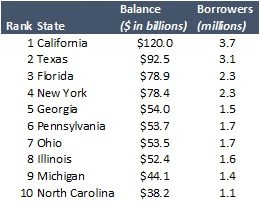
Not surprisingly, states with larger populations have higher aggregate student loan debt. California, Florida, Texas and New York are among the four highest states for total student loan debt outstanding among resident borrowers.
California, Florida, Texas and New York represent more than 20% of all U.S. student loan borrowers.
High Student Loan Debt States & Low Student Loan Debt States
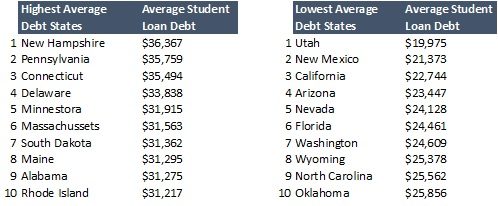
New Hampshire has the highest average student loan debt per student ($36,367) from the Class of 2016.
Utah has the lowest average student loan debt per student ($19,975) from the Class of 2016.
Student Loan Debt Per Capita In Select U.S. States
In the U.S., as of 2016, the average student loan debt per capita is $4,920. Pennsylvania, New York and Michigan have among the highest student loan debt per capita in the nation.
Arizona: $4,760
California: $4,160
Florida: $4,480
Michigan: $5,330
New York: $5,570
Ohio: $5,700
Pennsylvania: $5,690
Texas: $4,510
Distribution Of Student Loan Borrowers By Balance
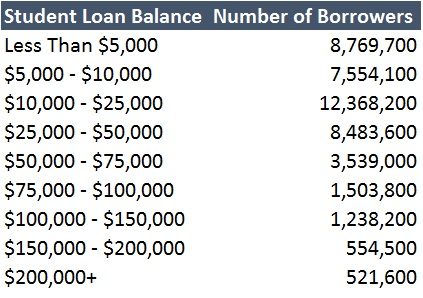
As of 2018, more than 42 million student loan borrowers have student loan debt of $100,000 or less.
More than 2 million student loan borrowers have student loan debt greater than $100,000, with 415,000 of that total holding student loan debt greater than $200,000.
The largest concentration of student loan debt is $10,000 – $25,000, which accounts for 12.4 million student loan borrowers.
Total Student Loan Balances By Age Group
Over the past five years, student loan debt balances have grown across each age category.
On a percentage basis, the largest increase in student loan debt has come from a surprising age group: 60 to 69-year-olds, who have experienced an 71.5% increase in student loan debt. However, on a dollar basis, this age group represents a $35.6 billion increase over the same period, which is the lowest increase among all age groups.
On a dollar basis, the highest increase in student loan debt is among 30 to 39-year-olds, who as a group now hold over $461 billion in student loans. On a percentage basis, the amount of student loan debt held by 30-39 year-olds has increased 30.2% over the past five years.
Number Of Student Loan Borrowers By Age Group
The largest concentration of student loan borrowers is under 30-years-old, followed by the 30-39 age group.
Therefore, there are 29.1 million student loan borrowers under the age of 39, with this group representing approximately 65% of all student loan borrowers.
As of 2017, here is the breakdown of student loan borrowers by age.
< 30-years-old: 16.8 million
30-39: 12.3 million
40-49: 7.3 million
50-59: 5.2 million
60+: 3.2 million
Student Loan Debt Outstanding By Student Loan Program
Over 33 million student loan borrowers hold approximately $1.1 billion in Direct Loans. Another 14.5 million student loan borrowers hold $301 billion in Federal Family Education Loans (FFEL).
Direct Loans: $1,066.8 billion (33.3 million borrowers)
Federal Family Education Loans (FFEL): $301.1 billion (14.5 million borrowers)
Perkins Loans: $7.6 billion (2.5 million borrowers)
TOTAL: $1,375.5 billion
Student Loan Debt Outstanding By Student Loan Type
Stafford Subsidized: $272.2 billion (29.6 million borrowers)
Stafford Unsubsidized: $463.3 billion (28.4 million borrowers)
Stafford Combined: $735.5 billion (33.0 million unique borrowers)
Grad PLUS: $59.6 billion (1.2 million borrowers)
Parent PLUS: $83.7 billion (3.5 million borrowers)
Perkins: $7.6 billion (2.5 million borrowers)
Consolidation: $489.0 billion (12.0 million borrowers)
Student Loan Debt Statistics By Loan Status For Direct Loans
Approximately $600 billion in Direct Loans across 17.8 million student loan borrowers are in student loan repayment. Approximately 11 million student loan borrowers are in student loan deferment, student loan forbearance or student loan default.
Student Loans In School: $133.5 billion (7.4 million borrowers)
Student Loans In Repayment: $600.0 billion (17.8 million borrowers)
Student Loans In Deferment: $103.0 billion (3.3 million borrowers)
Student Loans in Forbearance: $108.3 billion borrowers (2.6 million borrowers)
Student Loans In Default: $88.4 billion (4.7 million borrowers)
Student Loans In Grace Period: $25.9 billion borrowers (1.2 million borrowers)
Student Loan Debt Statistics By Repayment Plan For Direct Loans
There are 12.8 million borrowers with $233.5 billion of student loan debt in the Level Student Loan Repayment Plan (student loan repayment in 10 years or less), which represents the largest concentration of borrowers in student loan repayment.
The second most concentrated group of borrowers is enrolled in Income-Based Repayment (IBR) at $192.0 billion and 3.6 million borrowers.
Level Repayment Plan (< 10 years): $233.5 billion (12.8 million borrowers)
Level Repayment Plan (> 10 years): $79.1 billion (1.8 million borrowers)
Graduated Repayment Plan (< 10 years): $88.3 billion (3.3 million borrowers)
Graduated Repayment Plan (> 10 years): $14.3 billion (0.3 million borrowers)
Income-Contingent Repayment (ICR) Plan: $27.6 billion (0.6 million borrowers)
Income-Based Repayment (IBR) Plan: $192.0 billion (3.6 million borrowers)
Pay As You Earn (PAYE) Plan: $68.3 billion (1.2 million borrowers)
Revised Pay As You Earn (REPAYE) Plan: $108.8 billion (2.0 million borrowers)
Servicer Portfolio By Repayment Plan
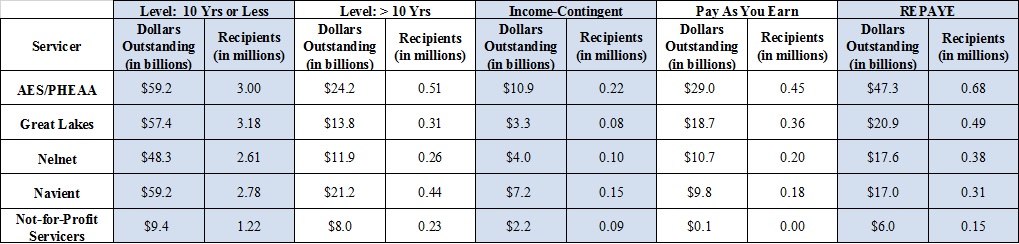
As of December 31, 2017, AES/PHEAA (otherwise known as FedLoan Servicing) and Navient service the largest portfolios of student loans in repayment in the U.S. FedLoan Servicing is the largest servicer of federal direct and Federal Family Education Loans.
The most popular student loan repayment plan is the Level Repayment Plan, which means student loan repayment in less than 10 years, followed by REPAYE (Revised Pay As You Earn).
Other Important Student Loan Debt Statistics
In addition, there are several other startling statistics regarding the state of student loan debt:
Nearly seven in 10 seniors (68%) who graduated from public and non-profit colleges in 2015 had student loan debt.
In 2012, 1.3 million students graduated with student loan debt.
In 2012, 66% graduated from public colleges, 75% graduated from private colleges and 88% graduated from for-profit colleges.
Almost half (47%) of private loan borrowers in 2011-12 borrowed less than they could have in federal Stafford loans for college.
While private loan volume peaked at $18.1 billion in 2007-2008, private loan volume is now $7.8 billion as of 2014-2015.
6% of all undergraduates – 1,373,000 students – borrowed private loans in 2011-12.
Four out of five 2016 graduates with state loan debt attended schools in just four states: Texas, Minnesota, Massachusetts, andNew Jersey that awarded only 14% of bachelor’s degrees.
Of the 100 colleges where graduates borrow most in private loans, 85 are nonprofit four-year colleges and 34 are located in Pennsylvania.
At public colleges, average debt in 2012 was $25,550 (25% higher than in 2008, when the average was $20,450).
At private nonprofit colleges, average debt in 2012 was $32,300 (15% higher than in 2008, when the average was $28,200).
At for-profit colleges, average debt in 2012 was $39,950 (26% higher than in 2008, when the average was $31,800).
About 20% of the Class of 2012’s student loans were private student loans.
Graduates who receive Pell Grants are more likely to borrow more debt: 88% had student loans in 2012, with an average of $31,200 per borrower.
Graduates who did not receive Pell Grants: 53% of those who never received a Pell Grant had debt, with an average of $26,450 per borrower — $4,750 less than the average debt for Pell recipients with debt.
(Source: The Institute for College Access and Success)
Student Loan Forgiveness
Student loan forgiveness comes in several forms. Two of the most popular types of student loan forgiveness are Public Service Loan Forgiveness and Teacher Student Loan Forgiveness.
As of December 31, 2017, there are 802,040 cumulative Public Service Loan Forgiveness borrowers.
Since 2012, 1,361,184 employment certification forms have been approved and 705,362 have been denied.
About 140,000 of student loan borrowers have applied for student loan forgiveness under the borrower defense to repaying rule since 2015.
(The above student loan debt statistics include data from The New York Federal Reserve Credit Panel/Equifax, The Institute For College Access and Success, National Student Loan Data System, Mark Kantrowitz, Federal Student Aid and FedLoan Servicing).For press inquiries regarding these student loan debt statistics, please contact us.
SoFi, also known as Social Finance, is a market leader in personal loans. Based in San Francisco, SoFi positions itself as the “anti-bank” and prides itself on being consumer-centric, with some of the lowest personal loan rates in the industry. In addition to personal loans, SoFi offers its members a number of perks such as customer support seven days a week and free SoFi events.
SoFi Personal Loan Overview
SoFi offers attractive rates and terms compared with other top lenders in the personal loan industry:
[sofi_pl_details]
[sofi_pl_button]
How SoFi Compares: Key Benefits Of SoFi’s Personal Loan
Here are some of the reasons that SoFi borrowers love SoFi personal loans:
Fast funding.
Easy application
Customer Service: SoFi offers live customer support 7 days a week
Eligibility Criteria
To apply for a SoFi personal loan, you need to meet the following eligibility criteria:
Requirements To Apply For SoFi Personal Loan
Minimum Age: At least age of majority in your state
Citizenship/Residency: U.S. citizen or permanent resident (applies to co-signer too, if any)
Employment: You are currently employed or have an offer of employment to start within next 90 days
Generally, SoFi lends only to borrowers with good to excellent credit. Loan approval may depend on a number of additional factors, including, but not limited to, your financial history, career experience and monthly income vs. expenses. SoFi does not focus on your FICO (credit) score in its underwriting process.
Bottom Line: Is SoFi right for you?
SoFi has a top reputation for personal loans and has received an A+ from the Better Business Bureau.
Remember, SoFi caters to borrowers with good to excellent credit and high incomes. Technically, SoFi does not have a minimum credit score or a minimum income. Practically, however, the average SoFi personal loan borrower has an average credit score of about 700+ and an average income of about $100,000.
You also need to be employed or have a job offer that begins in the next 90 days. SoFi also wants to see strong monthly cash flow that is sufficient to cover your life expenses and any other debt obligations.
You can use a SoFi personal loan for any purpose such as to pay off credit card debt, medical expenses, home improvement, engagement ring, wedding, honeymoon or new baby expenses.
Next Steps: How To Apply To SoFi
You can apply for a SoFi personal loan in 3 easy steps.
Step 2: Complete application and upload documents.
Step 3: Accept loan terms and get funded.
The good news is that you can check your new personal loan rate online with SoFi before you complete the full application. This way, you’ll know whether you can be approved for SoFi personal loan. Therefore, SoFi will provide you with an estimated personal loan rate. The pre-approval is only a soft credit pull so there is no impact to your credit.
If you have been pre-approved, you’ll need at least the following documents to complete the online application (which takes about 10-15 minutes):
Your most recent pay stubs
Driver’s license or passport (or other forms of government-issued identification)
Funding for your personal loan is quick and can occur within several days.
Applying is super easy – get your personalized rate in 2 minutes
If you want to know the best lenders to refinance and consolidate Parent PLUS Loans, you’ve come to the right place. Parent PLUS Loans typically have high interest rates, which can interfere with your retirement savings and become a financial burden. According to the latest student loan debt statistics, there are more than 3.5 million borrowers who collectively owe $80 billion of Parent PLUS Loans.
Parent PLUS Loan Refinancing is an effective tool to pay off Parent PLUS Loans. You can refinance Parent PLUS Loans to save money, lower your interest rate and pay off debt more quickly.
[refinance_parent_plus_loans_table]
Mentor can help you compare the best companies to refinance Parent PLUS Loans. We evaluate the best student loan companies across multiple factors, including reputation, customer service, trust, execution, interest rates, fees, flexibility and many more considerations.
When you refinance Parent PLUS Loans, you exchange your current Parent PLUS Loans for a new, single student loan with a lower interest rate. The goal of Parent PLUS Loan refinancing is to save money and pay off Parent PLUS Loans faster.
What are the best places to refinance Parent PLUS Loans?
Here are the best companies to refinance Parent PLUS Loans:
Earnest is one of the best companies to refinance Parent PLUS Loans. As one of the best student loan consolidation companies, Earnest differentiates itself by allowing you to choose your own student loan interest rate and loan term. Earnest also offers industry-leading repayment flexibility on your Parent PLUS Loans. With Earnest, you can choose your exact minimum monthly payment and increase your payment anytime to pay off Parent PLUS Loans faster.
Earnest allows you to refinance and consolidate both federal and private Parent PLUS Loans, including for both undergraduate and graduate school loans, into a new, single student loan. You can also skip a student loan payment and make it up later.
Earnest looks beyond credit score to approve you for Parent PLUS Loan refinancing, and will incorporate savings, education and earnings potential. Earnest services its own Parent PLUS Loans, so Earnest will be your student loan servicer when you refinance Parent PLUS Loans with Earnest. Parents with Parent PLUS Loans can also refinance and consolidate Parent PLUS Loans with Earnest.
Splash
Splash is a new lender that works with banks and credit unions to refinance Parent PLUS Loans. Splash has competitive rates and offers free Parent PLUS Loan refinancing for federal and private Parent PLUS Loans, including both undergraduate and graduate Parent PLUS Loans. Parents with Parent PLUS Loans can also refinance Parent PLUS Loans with Splash.
SoFi
SoFi is one of the most recognizable student loan consolidation companies and one of the best companies to refinance Parent PLUS Loans.
As one of the best lenders to refinance and consolidate Parent PLUS Loans, SoFi positions itself as the “anti-bank” and has some of the lowest student loan refinance rates in the industry. In addition to Parent PLUS Loan refinancing, SoFi offers its members several perks such as free career services, customer support seven days a week, and free SoFi events. SoFi also offers unemployment protection, so if you lose your job, SoFi will temporarily pause your payments for up to 12 months.
Laurel Road
Laurel Road is a bank that offers Parent PLUS Loan refinancing and Parent PLUS Loan refinancing, including for both undergraduate and graduate school loans.
Laurel Road has no fees and refinances both federal and private Parent PLUS Loans. If you are a parent and want to refinance Parent PLUS Loans that you borrowed for your child’s college, Laurel Road permits parents to refinance Parent PLUS Loans in their child’s name.
Laurel Road may allow borrowers to pause their student loan payments for one or more three-month periods (up to 12 months) through a forbearance if they face economic hardship.
Parent PLUS Loan refinancing is the process of lowering the interest rate on your Parent PLUS Loans. You can exchange your existing Parent PLUS Loans to receive a new loan with a lower interest rate. There are many potential benefits when you refinance Parent PLUS Loans, including saving money by having a lower interest rate.
With Parent PLUS Loan refinancing, you have flexibility to decide your student loan repayment term. You can pay off Parent PLUS Loans in a shorter time period with a higher monthly payment, or you can choose a lower monthly payment and pay off Parent PLUS Loans over a longer time period.
Parent PLUS Loan refinancing enables you to choose a new lender, choose a repayment term, select a fixed or variable interest rate, consolidate your federal Parent PLUS Loans into one monthly payment, and simplify your repayment with only one student loan servicer.
How do you get approved for Parent PLUS Loan refinancing? Lenders prefer borrowers with a strong credit score (at least in the mid 600’s and preferably in the 700’s), stable and recurring income and a low debt-to-income ratio. If you don’t meet these requirements, you can always apply with a qualified co-signer, who can help you get approved and receive a lower interest rate.
One benefit of Parent PLUS Loan refinancing is the ability to check your interest rate for free in about two minutes before you apply. You can do this with multiple lenders to determine which lender offers the lowest interest rate. The lender will do a soft credit check to determine your interest rate, and this has no impact on your credit score.
Remember, when you refinance Parent PLUS Loans, your new loan will be a private student loan. This means that you no longer will have federal student loan if you choose to refinance federal Parent PLUS Loans. When you refinance Parent PLUS Loans, you won’t have access to income-driven repayment plans such as Income-Contingent Repayment (ICR) or federal programs such as public service loan forgiveness or teacher loan forgiveness.
Learn more:
Compare the latest rates for Parent PLUS refinancing.
If you have Parent PLUS Loans, or your parents have Parent PLUS Loans, here is everything you need to know about how to pay off Parent PLUS Loans. Parent PLUS Loans are federal student loans that you can borrow from the federal government to help pay for a dependent’s education. It’s essential to know all your options to pay off Parent PLUS Loans.
[refinance_parent_plus_loans_table]
In this complete guide to pay off Parent PLUS Loans, you will learn how to:
Can you refinance Parent PLUS Loans? The answer is yes. Parent PLUS Loans typically have high interest rates, which can interfere with your retirement savings and become a financial burden. You can refinance Parent PLUS Loans to save money, lower your interest rate and pay off debt more quickly. There are two ways to refinance Parent PLUS Loans:
Refinance Parent PLUS Loans in your name only
Parent PLUS Loan refinancing in your child’s name
Refinance Parent PLUS Loans in your name only
Refinancing Parent PLUS Loans in your name only is the standard way that borrowers refinance Parent PLUS Loans. When you refinance Parent PLUS Loans, the process is similar to how to refinance student loans. To qualify for Parent PLUS Loan refinancing, you will need good credit, stable and recurring monthly income, and a low debt-to-income ratio. Lenders want to ensure that you can afford your monthly living expenses, plus debt payments for mortgages, student loans and credit cards. When you refinance Parent PLUS Loans, a private lender pays off your existing Parent PLUS Loans, which means you no longer will have the benefits of a federal government loan.
The process to refinance Parent PLUS Loans is simple. You can compare Parent PLUS Loans refinance lenders and then check your new interest rate for free in about two minutes with no impact to your credit score. Then, you can apply online in about 10-15 minutes.
Parent PLUS Loan refinancing in your child’s name
Can a Parent PLUS Loan be transferred to the student? Many Parent PLUS Loans borrowers ask whether they can transfer Parent PLUS Loans to their child. The short answer is no, you can’t directly transfer Parent PLUS Loans to a child. However, you can refinance Parent PLUS Loans in your child’s name with certain private lenders. To qualify, the student must qualify for student loan refinancing. That means your child must have good credit (at least 650 or higher), stable and recurring income, and a low debt-to-income ratio. Lenders want to ensure that your child can repay student loans, pay for living expenses, and pay other debt obligations such as credit card debt or a mortgage.
How To Consolidate Parent PLUS Loans
Many parents ask: Should I consolidate my Parent PLUS Loans? When you consolidate Parent PLUS Loans, you combine your existing Parent PLUS Loans into a single, Direct Consolidation Loan. You can even consolidate a single Parent PLUS Loan too. Parent PLUS Loan consolidation helps you to organize your existing Parent PLUS Loans into a single loan. When you consolidate Parent PLUS Loans, the repayment period is 10-30 years. While a longer repayment schedule may lower your monthly payment, you may pay more in total interest. The interest rate for a Direct Consolidation Loan is equal to a weighted average of your existing Parent PLUS Loans, rounded up to the nearest 1/8%. Therefore, Parent PLUS Loan consolidation doesn’t lower your interest rate.
How To Lower Your Parent PLUS Loan Payments
An income-driven repayment plan is one option to lower your Parent PLUS Loan payments. Income-driven repayment plans are federal repayment plans that cap your student loan payment at a percentage of your monthly income. Parent PLUS Loans are only eligible for Income-Contingent Repayment (ICR), which is one type of income-driven repayment plan.
Income-Contingent Repayment (ICR) lowers your monthly payment to the lesser of:
20% of your discretionary income; and
The amount you would pay on a fixed, 12-year repayment schedule
Choose an Income-Contingent Repayment (ICR) plan if you are unable to afford the Standard Repayment Plan, which is 10 years. To qualify for ICR, first you must consolidate your Parent PLUS Loans to a Direct Consolidation Loan. You also may be liable for income taxes if you receive any loan forgiveness.
How To Get Parent PLUS Loan Forgiveness
Many parent borrowers ask: Are Parent PLUS Loans eligible for forgiveness? Other parents ask: How can I get my Parent PLUS Loan forgiven?
If you want to know how to get Parent PLUS Loan forgiveness, the best way is through Public Service Loan Forgiveness. The Public Service Loan Forgiveness program is a federal program that offers student loan forgiveness. To qualify, you must be a full-time employee of a public service or non-profit employer. To get Parent PLUS Loan forgiveness, the employment of the parent borrower is what matters; not your child’s employment. You also must make at least 120 monthly student loan payments.
It is important to understand all the requirements of the Public Service Loan Forgiveness program. To qualify, you must first consolidate your Parent PLUS Loans into a Direct Consolidation Loan. Then, you must make a majority of your loan payments while enrolled in an income-driven repayment plan.
Parent PLUS Loans: Important Questions
What is the best way to pay off Parent PLUS Loans?
The best way to pay off Parent PLUS Loans depends on your personal circumstances and financial situation. The Standard Repayment Plan takes 10 years to pay off Parent PLUS Loans and is the most straightforward.
If you want to lower the interest rate on your Parent PLUS Loans, then Parent PLUS Loan refinancing is your best strategy. You can lower your interest rate, save money and pay off Parent PLUS Loans faster.
If you are struggling to pay off your Parent PLUS Loan, then you consider an income-driven repayment plan such as Income-Contingent Repayment (ICR). While you can lower your monthly payment, this strategy may be more expensive because interest still accrues on your Parent PLUS Loan.
Can you pay off Parent PLUS Loans early?
Yes, you can pay off Parent PLUS Loans early. Parent PLUS Loans are federal student loans, which can be paid off any time with no prepayment penalty.You may choose to pay off Parent PLUS Loans early, or you may decide to use those funds to save more for retirement.
Can Parent PLUS Loans be forgiven?
Parent PLUS Loans can be forgiven. The best way to get Parent PLUS Loan forgiveness is through the Public Service Loan Forgiveness program. You can receive Parent PLUS Loan forgiveness if you meet all requirements, including 120 monthly payments, and work for an eligible employer.
Do you have to pay back Parent PLUS Loans?
Parent PLUS Loan repayment begins immediately. The good news is that you are able to apply for student loan deferment while your child is enrolled in school and for six months after graduation. That’s why it is important to have a Parent PLUS Loan repayment strategy in place so that you understand all your options.
There are two main ways to get Parent PLUS Loan forgiveness. First, you can get Parent PLUS Loan forgiveness through an income-driven repayment plan known as Income-Contingent Repayment (ICR). Second, you can get Parent PLUS Loan Forgiveness through the Public Service Loan Forgiveness program. However, neither option may be the fastest way to pay off Parent PLUS Loans. The fastest way to pay off Parent PLUS Loans is to refinance Parent PLUS Loans. The second fastest way to pay off Parent PLUS Loans is to remain on the Standard Repayment Plan.
The amount of your fixed monthly payments on a 12-year repayment term.
When you enroll in ICR, your loan term will become 25 years. This is 15 years longer than the Standard Repayment Term for Parent PLUS Loans, which is 10 years. To enroll in ICR, your must first consolidate your Parent PLUS Loans into a Direct Consolidation Loan. To determine your monthly payment, you must certify your income. Each year, you will recertify your income, which could change your monthly payment.
After 25 years of on-time monthly payments, your remaining Parent PLUS Loan balance will be forgiven. It is important to note that the amount of Parent PLUS Loan forgiveness you receive is subject to income tax.
How to Get Parent PLUS Forgiveness Through Public Service Loan Forgiveness
The Public Service Loan Forgiveness program is a federal program that offers student loan forgiveness to employees who work for the government or a non-profit and make 120 monthly payments. To get Parent PLUS Loan forgiveness, the parent borrower’s employment is what matters; not your child’s employment.
It is important to understand all the requirements of the Public Service Loan Forgiveness program. To qualify for public service loan forgiveness, you must first consolidate your Parent PLUS Loans into a Direct Consolidation Loan. Then, you must make a majority of your loan payments while enrolled in an income-driven repayment plan such as Income-Contingent Repayment (ICR).
Each year or whenever you change employers, you must submit an Employment Certification Form to the U.S. Department of Education. After you complete all 120 monthly payments, you can submit an application for public service loan forgiveness. If you are approved, you will receive student loan forgiveness on your remaining balance. The amount of student loan debt forgiven is not taxable.
This Public Service Loan Forgiveness calculator shows you how much student loan forgiveness you can get with public service loan forgiveness.
How to Refinance Parent PLUS Loans
It can take a long time to get Parent PLUS Loan forgiveness, and your options are limited to Income-Contingent Repayment (ICR) and Public Service Loan Forgiveness. One option to consider is to refinance Parent PLUS Loans.
Can you refinance Parent PLUS Loans? The answer is yes. Like student loan refinancing, you can refinance Parent PLUS Loans to save money, lower your interest rate and pay off debt more quickly. There are two ways to refinance Parent PLUS Loans:
Refinance Parent PLUS Loans in your name only
Refinance Parent PLUS Loans in your child’s name
Refinance Parent PLUS Loans in your name only
Refinancing Parent PLUS Loans in your name only is the standard way that borrowers refinance Parent PLUS Loans. When you refinance Parent PLUS Loans, the process is similar to how to refinance student loans. To qualify for Parent PLUS Loan refinancing, you will need good credit, stable and recurring monthly income, and a low debt-to-income ratio. Lenders want to ensure that you can afford your monthly living expenses, plus debt payments for mortgages, student loans and credit cards. When you refinance Parent PLUS Loans, a private lender pays off your existing Parent PLUS Loans, which means you no longer will have the benefits of a federal government loan.
The process to refinance Parent PLUS Loans is simple. You can compare Parent PLUS Loans refinance lenders and then check your new interest rate for free in about two minutes with no impact to your credit score. Then, you can apply online in about 10-15 minutes
Refinance Parent PLUS Loans in your child’s name
Can a Parent PLUS Loan be transferred to the student? Many Parent PLUS Loans borrowers ask whether they can transfer Parent PLUS Loans to their child. The short answer is no, you can’t directly transfer Parent PLUS Loans to a child. However, you can refinance Parent PLUS Loans in your child’s name with certain private lenders. To qualify, the student must qualify for student loan refinancing. That means your child must have good credit (at least 650 or higher), stable and recurring income, and a low debt-to-income ratio.
How to Discharge Parent PLUS Loans
There are certain circumstances when you Parent PLUS Loans can be discharged. They include, among others:
You, as the Parent PLUS Loan borrower, die
Your child, for whom you borrowed a Parent PLUS Loan, dies
You become totally and permanently disabled
Your Parent PLUS Loans are discharged in bankruptcy
The school that your child attended closed before your child completed a degree
The school improperly said you were eligible to receive a Parent PLUS Loan
Parent PLUS Forgiveness: Final Thoughts
While you can get Parent PLUS forgiveness, the options are limited. You can consolidate your Parent PLUS Loans, enroll in Income-Contingent Repayment (ICR), and receive forgiveness after 25 years. Alternatively, you could consolidate your Parent PLUS Loans, enroll in ICR, make 120 monthly payments, and receive Parent PLUS Loan forgiveness after 10 years.
If neither option is appealing, you could remain on the Standard Repayment Plan and pay off Parent PLUS Loans after 10 years. Alternatively, you could pay off your student loans faster when you refinance Parent PLUS Loans.