Author: it-teaam

  • Top 10 Things To Know About Student Loan Refinancing

    Top 10 Things To Know About Student Loan Refinancing

    You’re ready to refinance your student loans. You’ve done your homework. You’re well informed. You’ve got this. Here is one more list to make sure you have everything on your list before you choose your student loan company and your student loan.

    [refinance_student_loans_table]

    1. Interest Rates Savings

    Compare the interest rates and loan terms of your current student loan with your new interest rate from student loan refinancing.

    Calculate your savings from student loan refinancing with the Mentor Student Loan Refinancing Calculator.

    2. Fixed vs Variable Interest Rates

    If you are switching from a fixed interest rate to a variable interest rate, your variable interest rate could rise in the future and change your monthly student loan payments for the better (lower interest rates) or the worse (higher interest rates).

    3. Borrower Reward Benefits

    Look for borrower reward benefit programs, as these can help reduce the total cost of your loan.

    4. Repayment Terms

    While extending the repayment term may lower your monthly student loan payment, you may end up paying more interest over the life of your refinance loan.

    5. Hidden Fees

    Understand if there are any upfront, origination, prepayment or other fees, as they could add to the total cost of your loan.

    6. Co-Signer

    Determine if your student loan company permits co-signers.

    7. Co-Signer Release

    Determine if your student loan company permits a co-signer release option.

    8. Reputation

    Ensure the lender and servicer are reputable and financially strong. The servicer is the organization you will be making payments to and interacting with over the life of your student loan.

    9. Refinancing vs Consolidating

    Understand and evaluate the various features and benefits of your current student loans, and any potential benefits that may be lost by refinancing federal and private education loans, such as the loss of any remaining grace periods.

    10. Student Loan Review

    Read our Reviews to choose the best student loan company for you.

    [related_posts post_1=’318′ post_2=’321′ post_3=’357′]

  • Student Loan Refinance Process

    Student Loan Refinance Process

    Now that you have made the decision to refinance your student loans, it is time to understand the student loan refinance process. Over the past five years, the process to refinance student loans has been simplified considerably. Gone are the days of piles of paperwork, long wait times, and bureaucracy.

    [refinance_student_loans_table]

    So, what does the student loan refinance process look like? Here are 6 steps to make the student loan refinance process seamless for you:

    1. Student Loan Refinance Process: Easy Application

    • All the student loan refinance applications are online and you receive a student loan interest rate offer typically within 2 minutes
    • The total student loan refinance application may take less than 15 minutes to complete
    • Co-signers and parents can also apply online as well

    2. Select Your Loan

    • You can choose a fixed or variable student loan interest rate
    • You can choose your loan term and decide how fast you want to pay off your student loan

    3. Submit Your Loan Documentation

    • You can submit your documentation online
    • Some lenders will allow you to take a photo of your documents, or even submit via text
    • Key documents include your:

     Driver’s license or passport (or government issued ID)
     Transcripts / Diploma to verify your degree
     Payoff statement from your current lender (if refinancing)
     Monthly rent amount or mortgage payments
     Two most recent pay stubs or tax returns (or offer letter of employment)

    4. Lender Underwriting Review

    • The lender will review your submitted documents and credit report
    • The lender will apply its proprietary credit model to ensure that you meet all its underwriting criteria

    You’re Approved!

    5. Review Disclosures & Sign Loan Documentation

    • Review truth in lending and other disclosure statements
    • Sign your student loan documentation

    6. Your Student Loan Is Disbursed

    • If you refinance your student loans, your lender will issue you a new student loan and directly pay off your existing student loan from your existing lender
    • If you borrow a new student loan, your lender will send the funds directly to your school

    [related_posts post_1=’318′ post_2=’321′ post_3=’357′]

  • How To Make Money From Trump Tweets

    How To Make Money From Trump Tweets

    Concerned that President-elect Donald Trump’s tweets could knock down the share price of your favorite stock?

    If you are an investor in (or an executive or employee at) a publicly traded company, then there is a new app to help you navigate the potentially choppy social media waters.

    It’s called Trigger Finance, and it is the brainchild of three Cornell computer science engineers who want to level the playing field between institutional and do-it-yourself investors. Founded in 2015, Trigger is a financial technology mobile platform that provides free real-time data to help retail investors invest more rationally through an event-driven, rules-based approach.

    “Our mission is to build the next generation mobile investing platform that uses natural language, a wealth of data and artificial intelligence to help investors invest more rationally through rules and discipline,” said Rachel Mayer, Trigger’s co-founder and chief executive officer.

    The company says that tens of thousands of investors with nearly $200 million in assets have linked their brokerage accounts to the Trigger platform.

    Mayer’s co-founders are Zafrir Schop, who serves as the company’s chief technology officer, and Adrian Soghoian, who serves as chief operating officer. The three co-founders met while earning their master’s degrees in computer science.

    [refinance_student_loans_table]

    How Trigger Works

    Trigger helps retail investors use specific news events, or triggers, to invest. Users can create their own custom triggers, or access triggers created by other users in the Trigger community. Users have created over 100,000 triggers based on various data, including stock performance, earnings announcements, economic events and percentage gains or losses in your portfolio. When the event occurs, Trigger automatically sends a real-time notification, and the user determines whether to invest based on the event.

    Trigger’s rules-based approach reduces every event to a simple “if-this, then that” statement.

    For example, “if oil trades below $30 per barrel, then buy Exxon” or “if interest rates rise 50 basis points, buy JPMorgan.” Investors can follow their favorite investor, receive alerts when that investor buys or sells a particular stock and then mirror the investor’s actions in their own brokerage account. For example, if Warren Buffett announces that he bought more Coca-Cola stock, a user can create a trigger to be informed real-time of Buffett’s purchase.

    “After leaving JPMorgan’s algorithmic trading division, I experienced the many pain points and the increasing gap between how professional investors and retail investors invest,” Mayer said. “Specifically, the lack of innovation from brokers (particularly on mobile), the rise of [robo-advisors] and the jargon barriers everyday investors face have left many do-it-yourself investors underserved. I wanted to help the everyday investor have access to the same data and tools that I had, and deliver it in a way that made sense and was simple.”

    While Trigger is not a broker-dealer, investors link their brokerage accounts to the Trigger iPhone app and can place trades with all major U.S. brokerages.

    Trigger is not the only company that monitors the intersection of social media and the stock market. Competition includes Dataminr, StockTwits and Motif Investing, among other companies. Institutional investors regularly use news and financial events such as earnings announcements or acquisitions (e.g., event-driven hedge funds) as well as share price movements (e.g., algorithmic traders) to influence trading decisions.

    Trump Triggers

    Trump’s ability to influence a company’s share price – up or down – with a single tweet is no secret. Companies such as Boeing, Lockheed Martin, Toyota, General Motors, Ford, Amazon and Macy’s each have appeared in the president-elect’s tweets.

    Source: President-elect Donald Trump’s Twitter account (@realDonaldTrump)

    To help retail investors respond more rapidly to these share price movements, Trigger developed “Trump Triggers” to notify its users when Donald Trump’s Tweet about a particular stock.

    “[We have had] overwhelming demand from our users since Trump won the election,” said Mayer. “They’ve seen his platform of choice is Twitter, and it’s causing large market moved in Fortune 500 companies. They want to stay informed and balance the risk to their portfolios”

    To date, the company created two Trump Triggers that users can access to make investment decisions:

    • If Trump tweets about any publicly traded stock
    • If Trump tweets about any stock in a user’s portfolio

    The Trump Trigger has become the company’s most popular trigger, surpassing the Federal Reserve interest rate movement trigger.

    “We’ve built our custom rules engine that can trigger [based] on a variety of data in real time (including tweets, insider filings, weather and more) that sends alerts and triggers investments for the end retail investor,” Mayer said. “We’ve started to lay the groundwork to use data science and machine learning to generate insights based on our triggers and give that back to our community.”

    Trigger’s Future

    Last year, Trigger raised about $1 million in seed capital from Wall Street executives, hedge fund investors, Ivy League machine learning professors and founders of several biotechnology and FinTech companies. The company expects to raise additional capital this year.

    [related_posts post_1=’375′ post_2=’378′ post_3=’574′]

  • Student Loan Refinance: Top 10 Benefits

    Student Loan Refinance: Top 10 Benefits

    When you refinance student loans, here are the Top 10 ‘must haves’ you should look for:

    1. Lower interest rate
    2. Flexible loan terms
    3. Significant savings compared to existing student loans
    4. Fixed and variable interest rates
    5. Dedicated and available customer service
    6. Ability to refinance federal and private student loans
    7. Online application
    8. Forbearance options in case of economic hardship
    9. Autopay discount
    10. Other benefits

    [refinance_student_loans_table]

    [related_posts post_1=’318′ post_2=’321′ post_3=’357′]

  • Student Loan Refinancing Rejection: How To Get Approved

    Student Loan Refinancing Rejection: How To Get Approved

    What are the reasons for student loan refinancing rejection?

    Don’t worry. If you have faced student loan refinancing rejection, you are not alone.

    The good news is that you can overcome these student loan denial reasons with these 7 secrets.

    [refinance_student_loans_table]

    How To Rebound From Student Loan Refinancing Rejection?

    Refinancing your student loans comes with many benefits: a lower interest rate, a lower monthly payment, one combined loan and the opportunity to pay off your student loans faster.

    That means that over the life of your student loans, you potentially could save up to tens of thousands of dollars.

    So, you check your new interest rate, prepare your application, assemble your documents and wait for a response.

    But, then student loan refinancing rejection strikes and the dream of all those savings quickly fades.

    What do you do next?

    You Mentor.

    Step 1: Diagnose the problem

    Student loan refinancing is an excellent tool to help lessen the financial burden of student loan repayment.

    However, getting approved for student loan refinancing is not guaranteed and student loan refinancing rejection may be in the cards. Why?

    While the federal government issues student loans, the federal government does not refinance student loans. Therefore, if you want to refinance student loans, you have to refinance only with a private lender.

    Each private lender has its own eligibility criteria, underwriting requirements and approval processes. If one lender denies your application and you face student loan refinancing rejection, the good news is that you can still apply to another lender – or reapply to the same lender – to obtain approval.

    If your application is denied, the lender has to provide a reason for the denial. Some common reasons for denial include:

    Insufficient Income: If you are unemployed or have low income, lenders may question your ability to meet your monthly life expenses, including debt obligations such as student loan payments.

    High Debt/Income Ratio: This ratio is expressed as a percentage, and measures the amount of your monthly debt payments as a percentage of your monthly income.

    Lenders understand that you may have other debt obligations such as a mortgage, but they want to make sure you can pay your student loan debt, other debt and life expenses.

    Lack of Work Experience: Many lenders want to ensure that you have stable employment, or at least a written job offer.

    This means that it can be difficult to refinance your student loans while you are unemployed, a student or a recent college graduate without sufficient work experience.

    However, some lenders will refinance student loans for medical residents or third year law school students with a written job offer, for example.

    Low Credit Score: Lenders want you to demonstrate a history of financial responsibility. Your credit score is one way to measure your financial health. If your credit score is too low, you may be ineligible to refinance student loans. Most lenders require a minimum credit score in the mid 600’s.

    Step 2: Apply To Other Lenders

    A rejection from one lender does not preclude you from receiving approval from another lender.

    Remember that each lender has its own eligibility and underwriting criteria.

    Therefore, you should apply to multiple lenders to increase your chances for approval and to find the lowest rate on your student loans.

    A student loan refinancing application takes only two minutes to receive your new interest rate.

    If you apply to multiple lenders within 30 days, typically this is treated as a single inquiry on your credit report.

    Step 3: Get A Qualified Co-Signer

    Ask your spouse, parent, grandparent or someone else close to you to act as a co-signer for your student loans. Your co-signer needs to have a strong credit profile and income, and be willing to be equally responsible with you for your student loan.

    Having a qualified co-signer can make the difference between “approved” and “denied”

    The good news for your co-signer is that after you are approved to refinance your student loans, many student loan lenders offer a co-signer release, which releases your co-signer of financial responsibility if the co-signer and you can meet certain qualifications.

    Step 4: Check Your Credit Report

    Lenders review your credit report and credit score to measure your financial responsibility.

    First, you need to understand the components of your credit report, including your outstanding debt obligations, credit utilization, history of payments and other metrics. Second, make sure that you have reviewed your credit report for any errors.

    If there are any errors, you should dispute them.

    You can obtain a free copy of your credit report from all three bureaus (Equifax, Experian and Transunion) through AnnualCreditReport.com

    Step 5: Consolidate Debt

    If you have outstanding debt, you should consolidate your debt into a lower interest rate loan.

    For example, if you have outstanding credit card debt, you should consider debt consolidation with a personal loan to lower your interest rate. You may be able to cut your current interest rate in half with a personal loan.

    Step 6: Pay Off Debt

    Lenders will evaluate your current debt-to-income ratio. One way to improve this ratio is to lower your debt burden.

    Your debt-to-income ratio is driven by two factors: debt and income.

    If you lower your debt or increase your income (or preferably both), you will improve your debt-to-income ratio.

    Use a monthly budget to cut expenses and manage your finances. Use the cost savings to make extra debt payments to reduce principal.

    If you want to pay off debt and reduce principal, avoid income repayment plans, which can increase your interest payments over time.

    Your goal is to reduce your loan principal so that your monthly payments decrease.

    Step 7: Increase Your Income

    The second way to improve your debt-to-income ratio is to increase your income.

    Ask for a raise.

    Find a higher paying job.

    Develop a side hustle with recurring monthly income.

    Higher income provides comfort to lenders that you will be able to repay your student loan debt in full and on time.

    It may take some work – and time – to improve your financial profile and boost your credit score.

    However, the investment will be worth the effort to reap the benefits of student loan refinancing.

    [related_posts post_1=’318′ post_2=’758′ post_3=’1273′]

  • The Best Medical School Student Loans

    The Best Medical School Student Loans

    Want to save money on your medical school student loans?

    Medical school is a considerable investment – both in time and money. Today, attending medical school can cost more than $300,000, according to the American Medical Association. Therefore, it’s important to evaluate and find the best medical school student loans to maximize cost savings.

    [private_student_loans_table]

    Here is a helpful framework to think about paying for medical school:

    • Step 1: Identify grants
    • Step 2: Find scholarships
    • Step 3: Borrow federal student loans
    • Step 4: Borrow private student loans

    Grants. Grants are a type of financial aid that you don’t have to repay. Access grants from your medical school or non-profit organizations. Typically, grants are based on demonstrated financial need.

    Scholarships. According to the American Medical Association, the average medical school student graduates medical school with over $180,000 in student loans. Scholarships are one tool that can reduce the need for student loans. Like grants, scholarships often don’t need to be repaid. There are both merit-based scholarships and need-based scholarships. Check with your college, medical schools, local and state governments, and non-profit organizations.

    Federal Student Loans. You can borrow federal student loans directly from the U.S. Department of Education. As a medical student, you can borrow up to the full cost of attendance. Typically, you should borrow federal student loans before borrowing private student loans. Why? Federal student loans offer multiple borrower protections, including income-driven repayment plans and student loan forgiveness, that aren’t available with private student loans.

    Private Student Loans. Private student loans are available from private lenders. Unlike federal student loans, private student loans offer either a variable interest rate or a fixed interest rate. If you have a good credit score, a private student loan could offer you a lower interest rate. However, a private student loan is ineligible for student loan forgiveness programs such as public service loan forgiveness, for example.

    If you are applying to medical school or already have been admitted, congratulations! If not, it is never too early to start planning for your medical school student loans.

    These lenders represent our top medical school student loan picks and may be able to help you save thousands of dollars on your medical school student loans by offering lower interest rates and lower monthly payments. That’s real money back in your pocket.

    Learn your new student loan interest rate in a matter of minutes.

    [related_posts post_1=’318′ post_2=’330′ post_3=’384′]

  • The Best Dental School Student Loans In 2021

    The Best Dental School Student Loans In 2021

    Want to save money on your dental school student loans?

    As you already know, dental school is a considerable investment – both in time and money. So, when it comes to your dental school student loans, you will need to understand your options beyond federal government loans. The average dental school student graduates dental school with over $240,000 in student loans. The good news is that there are several private student loan lenders who can offer competitive rates on your dental school student loans.

    If you are applying to dental school or already have been admitted, congratulations! If not, it is never too early to start planning for your dental school student loans.

    These lenders represent our top dental school student loan picks for 2021, and may be able to help you save thousands of dollars on your dental school student loans by offering lower interest rates and lower monthly payments. That’s real money back in your pocket.

    Learn your new student loan interest rate in a matter of minutes.

    [private_student_loans_table]

    [related_posts post_1=’318′ post_2=’330′ post_3=’384′]

  • 9 Super Money Rules To Build Wealth

    9 Super Money Rules To Build Wealth

    What are the 9 super money rules to build wealth?

    [refinance_student_loans_table]

    There are countless personal finance books, blogs and articles that offer advice on investing, savings, retirement and taxes.

    You could read all those books

    Or, you can listen to this University of Chicago social scientist.

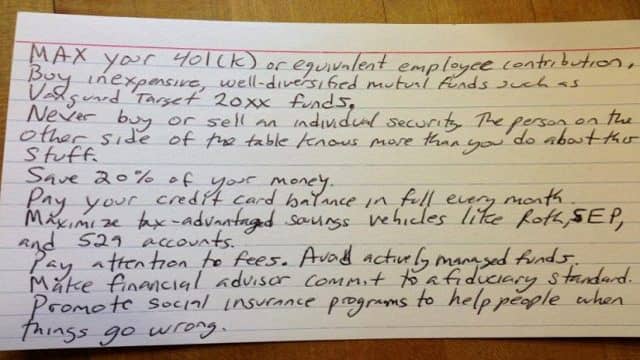
    His name is Harold Pollack, and when it comes to investment advice, he believes that you can fit all the investment advice you’ll ever need on a single index card.

    In 2013, Pollack interviewed personal finance writer Helaine Olen about her book, Pound Foolish. During their online video chat, Pollack shared his views on personal finance advice and what Pollack calls the “financial industry’s most basic dilemma.”

    “[The best personal finance advice] can fit on a 3-by-5 index card, and is available for free in the library,” Pollack said during the interview. “So, if you’re paying someone for advice, almost by definition, you’re probably getting the wrong advice because the correct advice is so straightforward.”

    Pollack’s comment was not intended to be the centerpiece of the interview. If anything, it was a one-off comment and he did not even elaborate on the specific financial advice.

    After Pollack posted the video, he started receiving emails asking where to find this index card and what was the advice.

    The problem: the index card didn’t exist.

    So, Pollack grabbed an index card from his daughter, wrote several personal finance principles, snapped a photo with his phone and posted it online. The actual index card was 4-by-6 inches (rather than 3-by-5).

    The result: the photo went viral.

    Following the success of the index card post, Pollack and Olen teamed to write a book, The Index Card: Why Personal Advice Doesn’t Have To Be Complicated. In the book, they elaborated on the simple financial advice that Pollack recorded on his index card (with a few modifications and the addition of a tenth rule).

    As the title suggests, the personal finance advice is simple and straightforward. Some of the rules are universal, while others are debatable.

    Here are Pollack’s 9 personal finance tips from his original index card:

    1. Max your 401(k) or equivalent employee contribution.
    2. Buy inexpensive, well-diversified mutual funds such as Vanguard Target 20xx funds.
    3. Never buy or sell an individual security. The person on the other side of the table knows more than you do about this stuff.
    4. Save 20% of your money.
    5. Pay your credit card balance in full every month.
    6. Maximize tax-advantaged savings vehicles like Roth, SEP and 529 accounts.
    7. Pay attention to fees. Avoid actively managed funds.
    8. Make financial advisors commit to the fiduciary standard.
    9. Promote social insurance programs to help people when things go wrong.

    [related_posts post_1=’375′ post_2=’378′ post_3=’574′]

  • Warren Buffett And Al Gore Both Trade This Stock

    Warren Buffett And Al Gore Both Trade This Stock

    Warren Buffett rarely likes technology stocks.

    His rationale? Stick with what you know. Buffett readily admits that he does not understand technology so he has avoided investments in the technology sector.

    Over the years, there have been exceptions to this rule – including Buffett’s investments in IBM and Microsoft, among others.

    Perhaps chief among these exceptions is Buffett’s investment in Apple. Over the past year, Buffett, through his holding company, Berkshire Hathaway, has amassed more than 61 million shares in Apple, making Berkshire a top 10 Apple shareholder with its 1% stake.

    Based on Friday’s closing price of $136.66, Berkshire’s stake in Apple is valued at approximately $8.3 billion. According to Berkshire’s annual report released today, Berkshire acquired its Apple stake at an average price of $110.17, which means Berkshire already has generated a paper profit of over $1.6 billion.

    Buffett continues to remain bullish on Apple, even as Apple’s share price hit an all-time high earlier this month.

    As Buffett continues to sing Apple’s praises, another investor has taken the other side of the bet.

    Former Vice President Al Gore.

    According to a filing yesterday with the U.S. Securities and Exchange Commission (SEC), Gore, an Apple board member, this week sold 215,437 shares of Apple stock worth about $29.5 million.

    Gore completed the sale on Wednesday through multiple trades ranging from $136.37 to $137.12 at an average sale price of $136.72.

    Gore acquired these shares four years ago by exercising stock options that he received as an Apple director to acquire 59,000 shares at a price of $7.48 per share (the pre-split adjusted value of $502.68) for a total cost of approximately $441,000.

    This sale is in addition to the 70,000 shares that, according to an SEC filing, Gore exercised for $13.02 earlier this month.

    After this week’s sale, Gore owns 230,137 shares of Apple stock worth about $31.5 million as of Friday’s close. Therefore, even has Gore has taken profits, he still holds a sizable stake in Apple.

    Gore has been an Apple board member since 2003 and is currently up for re-election to Apple’s board of directors at its upcoming annual meeting this Tuesday.

    [refinance_student_loans_table]

    [related_posts post_1=’375′ post_2=’378′ post_3=’574′]