Author: it-teaam

  • What’s The Most Well-Funded Technology Startup In Your State?

    What’s The Most Well-Funded Technology Startup In Your State?

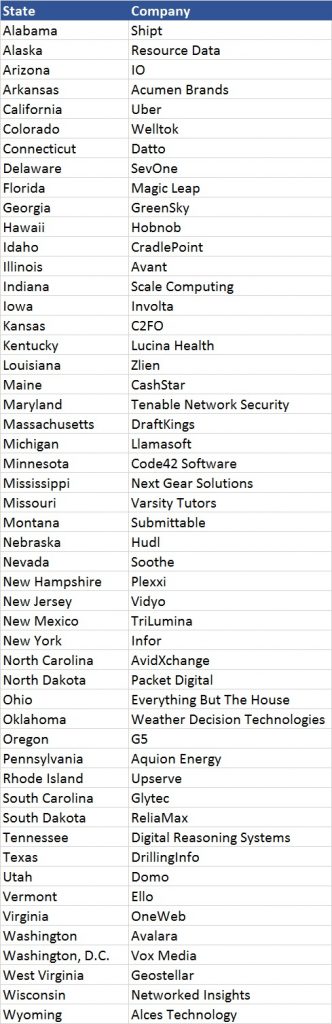
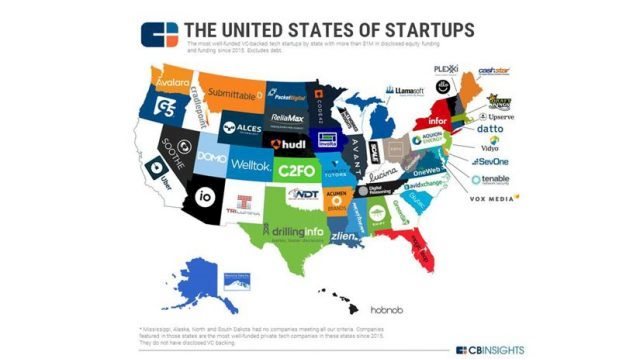
    A new map released by CB Insights identifies the most well-funded venture capital-backed technology startup in each state based on disclosed equity funding.

    The map includes companies in all 50 states, plus Washington, D.C. Four states – Mississippi, Alaska, North Dakota and South Dakota – did not meet CB Insights’ criteria, so the report includes the most well-funded private technology companies since 2015 in those four states.

    [refinance_student_loans_table]

    Here are some key takeaways:

    Most Well-Funded Startup

    • California-based Uber is the most well-funded startup on the map with $12.5 billion of funding to date

    Top “Unicorns”

    • There are nine “unicorns” (companies valued at $1 billion or more) that are also the most well-funded startup in their respective state: Uber (CA), Datto (CT), Magic Leap (FL), GreenSky (GA), Avant (IL), DraftKings (MA), Infor (NY), Domo (UT), and Vox Media (Washington, D.C.).

    Companies That Raised At Least $1 Billion in Equity Funding

    • There are seven companies on the list that have raised $1 billion or more in disclosed equity funding to date. These companies include, among others, OneWeb (VA), Infor (NY) and IO (AZ).

    Companies That Raised At Least $1 Billion In Equity Funding In A Single Funding Round

    • Companies that have (at least once) raised $1 billion or more in one round of funding include, among others, Uber (CA), OneWeb (VA) and Infor (NY).

    Companies That Raised More Than $100 Million in Equity Funding

    • There are 20 companies that have raised $100 million or more in disclosed equity funding to date.

    Companies That Raised Less Than $50 Million In Equity Funding

    • There are 17 companies that have raised less than $50 million, including Zlien (LA) and Hobnob (Hawaii)

    Here is the full list of companies and their accompanying states, including Washington, D.C.:

    Every Unicorn In The U.S.

    In December, CB Insights also released a map that includes every unicorn in the U.S.. The key takeaways from that map include:

    • The U.S. has 98 unicorns.
    • Collectively, U.S. unicorns are worth approximately $372 billion.
    • Collectively, these companies have raised over $67 billion.
    • As of December 2016, there are nine private U.S. companies valued over $10 billion.
    • As of December 2016, the three most valuable unicorns in the U.S. are Uber ($68 billion), Airbnb ($30 billion) and Palantir Technologies ($20 billion). These three companies are all located in California.
    • California has more unicorns than any other state, followed by New York and Massachusetts.
    • Ten other states have at least one company valued at $1 billion or higher.
    • The top five most well-funded U.S. unicorns are: UberAirbnbInforSnap and Palantir. (Snap has since filed for an initial public offering). All these companies – except Infor – are based in California.
    • The newest unicorn in the U.S. is a travel tech company, JetSmarter, which became a unicorn in December 2016.
    • The oldest unicorn in the U.S. is a greentech company, Bloom Energy, which reached a valuation above $1 billion in 2009.
    • The three most active venture capital investors in U.S.-based unicorns, by total number of deals, are: Sequoia CapitalAndreessen Horowitz and Khosla Ventures.

    [related_posts post_1=’375′ post_2=’378′ post_3=’574′]

  • This Wolf Of Wall Street Wants To Hire 70 Million People

    This Wolf Of Wall Street Wants To Hire 70 Million People

    Richard Bronson is not your typical CEO.

    Like many who hold his title, however, he has a vision. His is to help hire 70 million people.

    Not just any 70 million people, but specifically one subset of the U.S. population.

    According to Bronson, there are over 70 million Americans with a criminal record, many of whom cannot obtain employment due to their past. Bronson wants to help change that.

    It’s not Bronson’s first bold statement.

    In his prior life, before starting his latest venture – the for-profit job placement company, 70MillionJobs, which connects ex-offenders with viable employment opportunities – he was many things. A philanthropist. Founder of an asset management firm. A staple of the Miami social scene, with stints as Chairman of the Board of the City Ballet and Trustee of the Museum of Contemporary Art.

    By the way, he is also a convicted felon.

    His crime: securities fraud. Bronson also worked with Jordan Belfort at the same brokerage firm – Stratton Oakmont – glorified in the feature film, Wolf of Wall Street, starring Leonardo DiCaprio.

    I connected with Bronson on his latest venture, his criminal past, whether convicted felons deserve a second chance and his best business advice.

    [refinance_student_loans_table]

    Zack Friedman: You are a convicted felon. What happened?

    Richard Bronson: In the 1980’s, I went to work on Wall Street at several large investment banks. There was a pervasive attitude of “do whatever you have to do to make a lot of money.”  These were the “greed is good” days.

    I had friends who were working at a small brokerage firm on Long Island called Stratton Oakmont. They were making an enormous amount of money, and seemed to be having a ball doing it. So I went to work there, and in short order I became a partner of the firm. For the most part, what you’ve heard and seen of the place was accurate, although life is never quite as romantic as a Martin Scorsese film.

    I went on to found my own firm, and grew it from three people to more than 500, generating close to $100 million in annual revenue. Lots of what we did was wrong. I knew it was wrong, but I was greedy and impatient, and told myself that everyone was doing it.

    Eventually, government agents showed up on my doorstep, and I plead guilty to securities fraud. Luckily, my partner and I had repaid everyone who suffered losses, so my sentence was relatively lenient: I served 22 months.

    I wake up every day with a deep sense of shame over what I did.

    Zack Friedman: You have experienced the highest mountain tops and the lowest valleys. What did you learn from being both rich and poor?

    Richard Bronson: Humility is a great lesson to learn. When I was successful, I frequently was a jerk, and treated people with a lack of respect. I don’t believe I was put on this earth to create pain or misery, yet I was certainly guilty of just that. I’m not the first person to recognize that when you’re on top, everyone wants to be your friend. I crashed and burned, and only a few people stuck around, including my incredible family.

    I also learned that when you turn out the lights to go to sleep, the thread-count on your sheets means very little. If I worked at being a better man that day, I’ll sleep well. If not, I’ll try harder the next.

    Zack Friedman: You’re a strong believer in rehabilitation. Why do you believe that felons should be given a second chance?

    Richard Bronson: Having lived with hundreds of men in prison, I observed that as people they were no better or worse than those I knew on the outside. Mostly, they were folks who had very few options in life, and followed the path that others around them were following.

    So should they, or indeed anyone, be forced to serve a life sentence for a crime committed, often in their youth? Who among us hasn’t screwed up?

    I’m not talking about sociopaths or serial killers. None of us are perfect – certainly not myself – and lending a hand when someone deserving needs one, I think, is a pretty noble human inclination.

    The Internet never forgets, and as a result, people serve life sentences, often for crimes they committed when they were much younger.

    Zack Friedman: What response have you received from potential employers?

    Richard Bronson: Employers often have a negative bias to hiring applicants with criminal records. It’s certainly understandable. But there are new studies that suggest that ex-offenders can actually be better employees than those without records. It makes sense: they’re used to following directions, they’re truly appreciative for an opportunity, and they’re extremely careful not to mess up on the job. Add to [the U.S. Department of Labor’s] Federal Bonding Program that exists to insure at-risk employees [for the first six months of employment at no cost to the employee or employer], as well as significant federal tax credits, and you have a solution that’s not just good for society, but also good business.

    Our applicants have, on average, little experience negotiating the path to traditional employment. Their resumes are often tragically barren of “legitimate” experience. So we’re creating a platform for them to create video resumes, which will humanize them beyond a line on an arrest report, and show employers that these folks can be charming, smart, personable and potentially a real asset.

    Zack Friedman: 70MillionJobs recently announced a pilot program with the City of Los Angeles under Mayor Eric Garcetti’s Office of Reentry. What role can city and state governments play in giving ex-offenders a second chance?

    Richard Bronson: There’s nearly an 80% chance that someone released from jail or prison will be rearrested within five years. Nearly 90% of these people will be unemployed at the time of their arrest. This out-of-control recidivism costs cities like Los Angeles tens of billions of dollars annually, destroys lives and families, erodes society, to say nothing of the impact on the new victims. We think that progressive cities and states are recognizing the economics of recidivism and are looking for business solutions. That’s our big opportunity over time. Employment is the silver bullet.

    One by one, cities and states are enacting Fair Chance laws that allow folks with records at least a chance to get their foot in the employment door. In places like New York City and Los Angeles, “ban the box” laws prohibit asking job applicants if they have a criminal record. But as long as you can do a Google search, your past is nearly impossible to put behind you.

    Zack Friedman: What impact do you hope to create with 70MillionJobs?

    Richard Bronson: My goal was to be responsible for one million men and women having an opportunity – maybe for the first time in their lives – to truly live the American dream.

    The businessman in me wants a big number; the human being in me would be happy if there were even just one.

    Zack Friedman: You have been involved in multiple entrepreneurial endeavors. What are your 3 best pieces of business advice?

    Richard Bronson:

    1. Talk to your customers. Listen to the market. What you think matters little. Desert your ego.
    2. Don’t be afraid to fail. Greatness lies in the vast space of uncertainty. Take a chance. Swing for the seats. Why shouldn’t you achieve greatness?
    3. Be honorable. Smile a lot. Take deep breaths.

    [related_posts post_1=’375′ post_2=’378′ post_3=’574′]

  • PayPal Co-Founder Max Levchin Shares His Best Career Advice

    PayPal Co-Founder Max Levchin Shares His Best Career Advice

    He’s the visionary entrepreneur behind some of the top names in tech – PayPal, Yelp, Slide and others.

    As a board member, he’s helped steer Yahoo and Evernote.

    Now, Max Levchin’s latest venture, the financial technology company Affirm, is seeking to bring more accountability and transparency to the banking industry through what he calls “fair and honest financing.”

    According to CreditCards.com, the average amount of credit card debt is about $9,600. If you make the minimum monthly payment, you could pay more than $11,615 in additional interest during the life of the loan — which is more than you originally borrowed.

    Levchin wants to change that.

    Affirm lets shoppers pay for purchases — such as a Casper mattress or Peloton bike — over time with simple-interest loans that are free of any penalty or late fees. Unlike payment options that have compounding interest and unexpected costs, Affirm shows customers upfront exactly what they’ll owe.

    Is Affirm (a member of the Forbes Fintech 50 for 2016) the next credit card killer?

    Last month, the San Francisco-based company completed its 1 millionth consumer installment loan. Affirm has also attracted some of the top names in venture capital, including Andreessen Horowitz, Founders Fund, Khosla Ventures, Lightspeed Venture Partners and Spark Capital, among others.

    Levchin co-founded Affirm with Palantir co-founder Nathan Gettings and Jeff Kaditz.

    In this interview, we speak with Levchin about Affirm, his passion for problem solving, how to hire a great team, his best advice for entrepreneurs, and whether he can beat Peter Thiel in chess.

    [refinance_student_loans_table]

    Mentor: What was the impetus to start Affirm, and how did you come up with the idea?

    Max Levchin: We started Affirm 5 years ago with the thesis that we could build smarter underwriting and anti-fraud technology to improve on the tired traditional systems, and therefore create financial products that are simple, transparent, fairly-priced and free of incentive misalignment that so often defines consumer banking.

    Since 2014, our loan volume has grown 40+ times over, we’ve added 900 merchant partners including Expedia, Wayfair, Peloton, Casper and Eventbrite, issued more than 1 million loans, all while maintaining an industry-first Net Promoter Score (NPS) of over 70.

    Mentor: How is Affirm different from its peers?

    Max Levchin: We brought total price transparency to the financial products we offer, and eliminated gimmicks and fine print that cost Americans tens of millions of dollars every year.

    We built all our systems from the ground up – from general ledger to the underwriting models to customer service tools, which gives us the ability to innovate very rapidly, while understanding and controlling our risks.

    Mentor: You have been a long proponent of increasing financial transparency in the financial services industry. Where would you like the Consumer Financial Protection Bureau (CFPB) to focus its efforts in the coming years?

    Max Levchin: Since 2001, the [CFPB] found that more than 29 million consumers had been harmed by illegal practices perpetrated by bad actors in the finance industry.

    However, those are just the illegal practices.

    There are also several legal, yet equally harmful, practices being used by the industry today that are disproportionately affecting the most financially vulnerable populations.

    One of the most egregious is “deferred interest” products.

    I would also like to see the CFPB affirm a consumer’s right to access and permission their financial data. Doing so expands access to credit for the 58 million Americans considered credit invisible – those with no credit files or insufficient information in their files to generate a credit score.

    Mentor: What can we expect from Affirm in the next five years, and how will Affirm be positioned within the broader FinTech landscape?

    Max Levchin: We are on a mission to build a globally loved brand of financial services.

    Over the next few years, we [plan] to offer many more services expected from a modern financial institution, while bringing transparency to the industry where too often the customer has to lose for the service provider to win.

    We believe there is a better way.

    Mentor: Before you founded PayPal with Peter Thiel, what did you and Peter discuss during your first meal together at Hobee’s about “creating the new world currency?”

    Max Levchin: Mostly about cryptography and its impact on the rapidly changing world.

    Mentor: Speaking of Peter Thiel, who’s a better chess player – you or him?

    Max Levchin: Peter is significantly better at chess.

    Mentor: How about ping pong?

    Max Levchin: Not sure who’s better at ping pong, but I’d bet on me in that contest.

    Mentor: Successful entrepreneurs often don’t become successful without some failure. How has Max Levchin failed, and what did you learn from it?

    Max Levchin: Four startups I cofounded before PayPal all failed. Luckily, I was young enough to really have nothing to lose each time I started a new one.

    Mentor: What advice do you have now for your 20-year-old self?

    Max Levchin: Trust your gut more often!

    Mentor: After PayPal, you failed in a different way at your next venture, Slide. Why?

    Max Levchin: Financially, it was a good outcome, and I hired some of the best people I’ve had the opportunity to work with – but I was never truly passionate about the underlying problems the company was focused on.

    I was so focused on making Slide a success that I failed to realize I was happiest when trying to fix really hard technical problems.

    Mentor: Tell me more about your passion for problem solving. How do you approach a complex problem? Where do you start, and what’s your process?

    Max Levchin: I’m a computer scientist by training, and approach most challenges looking for an efficient algorithm as a solution.

    First, I always attempt to gain a thorough understanding of the system I am solving within. Once I understand how it works, I look for an efficient path within it, but if one doesn’t exist, I try to change the rules.

    These days, I find it’s absolutely crucial to consider the human elements of any system and corresponding solutions – any company is successful fundamentally only because of its team.

    Understanding how to build a great one and bring it together to solve problems is essential in creating leverage.

    Mentor: So, it’s not only building the right team, but also building the right team that can solve problems. What then is the trick to hiring great people?

    Max Levchin: Assuming professional qualifications are strong, I use the “avoidance test” – if after spending an hour listening and talking to them I imagine wanting to spend more time with the next time I see them, it’s probably a great hire.

    Mentor: As a CEO, do you have a daily ritual that you do to prepare for your day?

    Max Levchin: Unless it is entirely unfeasible, I ride my bike first thing every morning, typically around 5 am.

    Mentor: As an investor, where would you invest your money today within the FinTech / technology sector? What themes appeal to you?

    Max Levchin: I look for ideas that have customer retention strategies built in.

    A life time value of a happy financial service customer can be significant, but the cost of user acquisition is often extremely high (a typical [cost to acquire a credit card customer] is $100+) – so ideas designed to create and ultimately monetize loyalty can be very valuable.

    Mentor: What three things do you look for when you invest in an entrepreneur?

    Max Levchin: Drive, grit and raw intelligence.

    Put differently, entrepreneurs need to have an itch to actually get things done, an immense amount of fortitude given how consistently brutal this career is, and a strong command of the problem they’re trying to solve.

    Mentor: What advice can you offer to an aspiring entrepreneur who wants to be the next Max Levchin?

    Max Levchin: Find the company that’s best for you. You won’t succeed trying to solve a problem you’ve only convinced yourself you’re passionate about – likely not financially, and certainly not personally.

    Trying to be the next Steve Jobs or Bill Gates is a sure way to not be that.

    This also takes total commitment. So, if you’re unsure if being a founder is for you, the best thing you can do is join a startup – learn what it’s like without the pressure of carrying the ultimate responsibility.

    [related_posts post_1=’327′ post_2=’761′ post_3=’430′]
  • These ‘Flower Tech’ Companies Disrupt The Status Quo

    These ‘Flower Tech’ Companies Disrupt The Status Quo

    Over the past 40 years, the consumer floral category has undergone multiple technological transformations: retail stores, telephone, online – and now mobile.

    1-800-Flowers has deftly adapted and flourished through each of those market shifts.

    Jim McCann opened his first flower shop on First Avenue in New York City in 1976. Today, he and his brother, Chris McCann, have built 1-800-Flowers into a market leader with nearly $1.2 billion in annual sales.

    The iconic brand, which has been a publicly traded company since 1999, has continued to adapt to consumer demand. While its name suggests solely a floral focus, the company has expanded beyond flowers to become a multi-brand gift leader with offerings that include gourmet chocolates, cookies and fruit. The 1-800-Flowers family now includes brands such as Harry & David, Cheryl’s, Fanny May, Fruit Bouquets and The Popcorn Factory, among others.

    Flowers remain an essential part of the business, but its other brands generate the majority of revenues. The gourmet food and gift baskets business, for example, comprises 57% of the company’s annual revenues (compared with the consumer floral category at 36%).

    Just like 1-800-Flowers, which has disrupted the floral industry over the past four decades, the next-generation disruptors of “Flower Tech” are shaking up the landscape.

    [refinance_student_loans_table]

    The Bouqs Company

    Meet The Bouqs Company.

    Last week, the Los Angeles-based online floral retailer announced its $24 million Series C fundraising round led by new investor Partech Ventures. The Bouqs Company delivers flowers fresh from eco-friendly sustainable farms around the world to doorsteps nationwide.

    You might remember the company’s CEO, John Tabis, from his unsuccessful Shark Tank pitch in 2014. Flash forward three years and Tabis has raised $43 million, achieved an annual growth rate of 200% and a cash flow positive 4Q 2016.

    “It is rare to find a combination of fundamental industry disruption, rapid growth and cash efficiency due to strong operating leverage in an e-commerce business at this stage,” said Mark Menell, a general partner at Partech Ventures, in a statement announcing the company’s Series C fundraising round. “Customers absolutely love The Bouqs Company, and it’s clear they are the next generation leader in the space. With a tech-driven and proprietary supply chain, a stellar team, and a $16 billion market opportunity in the U.S. alone, we are beyond excited to support the company’s mission of building the floral brand of the future.”

    Partech Ventures joined NextEquity Partners and Reimagined Ventures as well as existing investors Azure Capital Partners, KEC Ventures and Quest Venture Partners. While Tabis did not get a deal on Shark Tank, Robert Herjavec, one of the show’s sharks, is now an investor.

    Founded by Tabis and his college classmate, Juan Pablo Montfar, The Bouqs Company is disrupting the global floral industry by reinventing the traditional supply chain. By eliminating multiple overhead cost layers such as warehouses, importers, distributors and auctioneers, The Bouqs Company is using technology not only to save costs, but also to streamline the supply chain.

    “We deploy our proprietary technology at farms around the world, connecting the source of our beautiful product with buyers directly,” Tabis said. “We use the data we collect on farmer crops and production, and pair it with user preferences, behaviors and attributes to make the market in real time. [This] drastically reduces the time from farm to table, virtually eliminates waste, ensures transparency of source and gets fresher flowers for less money into the hands of our clients and their loved ones.”

    With its fresh capital raise, The Bouqs Company is investing in both user experience and supply chain optimization technology, with a major focus on scaling the business.

    “Our brand and our supply chain really set us apart,” Tabis said. “Other players have to deal with a long, convoluted and wasteful supply chain that leads to expensive bouquets that are weeks old upon delivery. By going direct to the source, we deliver more blooms for less, and fundamentally change the price-value equation for consumers.”

    Meet BloomThat

    Founded by David Bladow, Matthew Schwab and Chad Powell, BloomThat began with a simple premise: deliver flowers anywhere in San Francisco within 90 minutes.

    Today, the California-based BloomThat delivers nationwide with next-day delivery – with customers in New York, San Francisco and Los Angeles able to receive same-day delivery in either a burlap bag or vase. Customers can choose from several curated bouquets.

    Overall, BloomThat’s founders say that the company is focused on spreading happiness for life’s big moments and everything in between.

    “BloomThat was founded on the premise of encouraging people to be more thoughtful – sending blooms outside of holidays and more often celebrating the ‘just because’ moments,” said Schwab, who also serves as the company’s president.

    Schwab is focused on bringing transparency back to the “outdated” floral industry, which has made Valentine’s Day “about baby’s breath, red roses and cellophane.”

    “There’s been a lack of transparency – the flowers you order online are more often than not different than what your recipient gets, [while] sending flowers to someone special has become a behavior reserved for a couple holidays a year,” Schwab said. “The choices we are making as a brand are changing those behaviors and serving the evolving consumer.”

    BloomThat has relied primarily on proprietary technology to drive its platform, which Schwab believes has differentiated BloomThat from its peers.

    “We have built almost all of our technology and infrastructure in-house, rather than using pre-existing platforms,” Schwab said. “That decision was imperative to create a frictionless consumer experience and glean information to operate at scale. Our technology allows for a much easier, enjoyable experience. For example, our average checkout time is one minute (actually, one of our most common customer inquiries is that the user checked out so fast, they forgot to put in their promo code).”

    Like 1-800-Flowers, BloomThat is evolving beyond flowers with non-floral gifting options as well as “BloomThat For Business,” which offer one-of-a-kind gifts such as thank yous for clients or a gift to welcome a new employee. Schwab is also focused on “Bloom Bars,” which are floral team-building events for corporate customers.

    “In addition, we’re looking to expand the functionality of our app, exploring new ways to send blooms without the previous barriers,” Schwab said. “For example, instead of asking for someone’s address (and ruining the surprise) or digging through your inbox for an address on file, perhaps you just send us their email and we’ll be able to handle the rest. Another future focus is lowering next-day shipping costs by opening new distribution centers and perhaps adding some same-day markets across the country.”

    BloomThat has attracted a bevy of top investors, including First Round, Forerunner, Vaizra Investments, Rothenberg Ventures, SherpaVentures and Ashton Kutcher’s A-Grade. Joe Montana is also an investor. BloomThat was also seeded through Y-Combinator. Most recently, BloomThat raised $5.5 million in its Series A in 2015.

    Other Market Players

    1-800-Flowers, The Bouqs Company and BloomThay face competition from other start-ups and established brands, including, among others:

    • Urban Stems (investors include Middleland Capital, SWaN and Legend Ventures Partners)
    • Bloom Nation (investors include Andreessen Horowitz)
    • H.Bloom (investors include Shasta and Battery Ventures)
    • FTD (founded as Florists’ Telegraph Delivery in 1910)
    • Teleflora (same parent company as POM Wonderful and Fiji Water)

    [related_posts post_1=’375′ post_2=’378′ post_3=’574′]

  • Student Loan Consolidation Questions

    Student Loan Consolidation Questions

    Top 15 Student Loan Refinance Questions

    Is student loan refinancing right for me” may be one of the many student loan consolidation questions on your mind.

    Lower rates. Lower monthly payments. Pay off student loans faster.

    For many, refinancing student loans can be a prudent strategy to save money on student loans and lower your monthly payment.

    Plus, the student loan refinance process can be done online and in less than 15 minutes.

    Let’s jump right in with the top student loan consolidation questions when you refinance student loans.

    1. Am I Good Candidate To Refinance My Student Loans?

    When you first borrowed your student loans, you may have had both a federal student loan and a private student loan. Your federal student loan is likely at the same high rate as everyone else’s federal student loan, since the federal government offers the same fixed rate to all borrowers. If you have a private student loan, it likely is a variable rate loan with a high interest rate. This is because when you borrowed that loan, you were in school and you may have had a limited credit history, which meant that your student loan company deemed you a higher credit risk.

    Now, you may have graduated, become employed, and developed a stronger credit history. As a result, you may be able to qualify to consolidate and refinance your existing federal student loans and private student loans into a new private loan with a lower interest rate.

    If your goal is to obtain a lower interest rate, lower your monthly payments, switch from a variable interest rate to a fixed interest rate (or vice versa), or change the loan term to a longer to shorter number of years to repay your loan, then you may be a good candidate to refinance student loans.

    The federal government, through the U.S. Department of Education, does not refinance student loans. However, you can refinance both federal student loans and private student loans with several private student loan companies.

    2. Should I Choose A Fixed Interest Rate Loan Or A Variable Interest Rate Loan?

    It is really a personal choice and should be considered along with your finances, loan amount and loan term.

    If you like the predictability of paying the same amount each month and don’t want to worry about your monthly payments potentially changing each month, then a fixed rate loan is probably best for you. Plus, if you plan to pay off your loan over a longer time period (e.g., 10-20 years), then you may prefer to lock in your interest rate now and not be impacted by changes in interest rates in the broader market.

    Variable interest rate loans are typically priced lower than fixed rate loans and can offer more savings initially. If you plan to pay off your loans over a shorter time period (e.g., 10 years or less), then you may prefer to choose a variable rate loan. However, if interest rates rise, then you should be prepared to make higher monthly payments and pay higher total interest over the life of the loan.

    3. Do I Have To Pay An Origination Fee?

    By the way, what is an origination fee? An origination fee is a charge upfront from the student loan company to process an application for a new loan.

    Most student loan companies do not charge an origination fee to refinance your loan. Why? Well, it is hard to justify charging a customer for an origination fee when you already have an existing student loan and are just refinancing the student loan to a lower interest rate.

    Some student loan companies do charge an upfront origination fee on “in school” loans (typically 2% or less), which are loans that one borrows while one is a student.

    4. Can I combine my federal student loans and private student loans when I refinance student loans?

    Yes, you can combine federal and private student loans with certain student loan companies when you refinance student loans. You also may be able to refinance student loans that you previously consolidated with the federal government through the U.S. Department of Education (e.g., Direct or FFEL) or a private student loan company.

    Double check with your lender when you refinance your student loans to make sure. Also, when you refinance your federal student loans, you lose most flexible student loan repayment plans and other protections connected with a federal student loan. That said, some student loan companies offer flexible student loan repayment plans, including deferment forbearance.

    Again, you should check with your new prospective student loan company and be sure to ask the new student loan company the differences between your new, refinanced student loan and your existing federal student loan.

    5. Will I Need A Co-Signer For My Student Loans?

    If you have a limited credit history, you may need another creditworthy person (e.g., a parent, spouse, relative or friend supportive of your educational goals) to help you qualify for a loan. A creditworthy cosigner is one who has strong credit and an ability to repay the loan.

    The benefit of a co-signer is that a lender considers the income and credit history of both you and the co-signer, which improves your chances of being approved for a student loan. A co-signer is equally responsible with you for the loan obligation.

    Some lenders offer a co-signer release, which means that a co-signer can be “released” from your student loan and would no longer have an obligation to pay your student loan.

    6. Is my school or degree eligible for student loan refinance?

    Be sure to check the student loan company’s website or call the student loan company’s customer service team to check school and degree (and other) eligibility requirements. For example, many private lenders lend to student loan borrowers from accredited Title IV university and graduate programs. Title IV schools are higher educational institutions eligible to offer federal student loans to its students under Title IV of the Higher Education Act of 1965.

    Each student loan company has different eligibility criteria to Student Loan Refinance, which may include being a U.S. citizen or permanent resident, your employment status, historical financial responsibility, and income and expenses, among other factors.

    7. Can I get an autopay discount?

    Yes! Most lenders offer up to 0.25% discount off your student loan interest rate if you sign up for auto pay. This means you receive an interest rate reduction of 0.25% on the total amount of your student loan so long as you authorize the loan servicer to automatically deduct monthly payments from your bank account. For example, if your interest rate on your new loan is 3%, you can lower your interest rate on your new loan to 2.75% (which is equal to 3.0% – 0.25% discount) for the life of the loan so long as you remain signed up with auto pay.

    8. What will my monthly student loan payments look like?

    Hopefully lower than what you are currently paying! You are in the driver seat – so you should consider a student loan that fits your personal and financial needs. Your monthly payment is primarily a feature of your interest rate, loan term and loan amount.

    • Fixed Interest Rate. If you have a fixed interest rate, your monthly student loan payment will remain constant each month for the duration of your loan.
    • Variable Interest Rate. If you have a variable student loan payment, your monthly loan payment may change each month based on the underlying benchmark such as 1 Month LIBOR.
    • Shorter-Term Loan. If you have a shorter-term student loan (e.g., 10 years or less), your monthly payments may be higher than if you have a longer-term loan (more than 10 years) because you have a shorter period to pay off the loan.
    • Longer-Term Loan. The longer the term of your loan (e.g., the number of years to pay back your loan), the more interest that will accrue over time and the more interest you will owe.

    So, you should decide how much you can afford to pay now versus over time and find the loan product that works best for your personal and financial needs. And remember – most student loan companies offer up to 0.25% discount off your interest rate if you sign up for auto pay. The autopay savings can really add up.

    9. How much time will I have to repay my student loan?

    That’s entirely up to you. Most lenders offer a variety of terms for student loan repayment that range from 5 to 20 years. You will want to think about your financial situation today and if you want to have lower payments and spread out your student loan payments over a longer time period, or whether you want relatively higher loan payments each month so you can pay off your loan faster.

    For example, with a fixed rate student loan, you will have higher monthly payments with a 10-year loan compared to a 20-year loan, but you will save 10 years’ worth of interest costs by paying your loan off in 10 years (rather than 20 years).

    10. What is the maximum student loan amount that I can borrow?

    Each lender’s maximum student loan amounts vary, but some student loan companies have no maximum limit.

    11. After I refinance my student loans, what kind of customer service can I expect?

    This should be one of your top questions. Since you will be tied to this student loan company for a long time (think 20 years if you have a 20-year loan), you need to make sure the student loan company is attentive, available and answers your questions promptly. Are they friendly when you call? Are they patient in answering questions? Are they accessible via phone, email and/or chat? Are they problem solvers? Do they want to make your life easier?

    Overall, you should make sure you are comfortable with the student loan company’s customer service team.

    12. After I refinance my student loan, what if the student loan company sells my student loan?

    It happens – and a lot more than you think. You may refinance your student loan with a new lender, start getting comfortable with the new lender, and wham – you receive a letter in the mail stating that your student loan has been sold to a new student loan company. Suddenly, thoughts run through your head. Why me? Was something wrong with my student loan? Have I been tricked? Where are they sending me? Will this now change the terms of my student loan?

    All reasonable questions. The short answer is…don’t worry.

    It is very common for even the best student loan companies to originate a new student loan or refinance student loans only to sell that student loan to a third party down the road. Loan sales is one of the way that student loan companies make money and is a very common legal practice in the student loan industry. If your student loan is sold, you likely were not singled out. Rather, your student loan was likely sold with other student loans in a group sale transaction.

    When a student loan sale is made, the terms of your student loan do not change based on the sale itself. Even if you have a new student loan company who purchased your student loan, that new student loan company is required to adhere to your existing student loan terms.

    You should focus on whether the servicer of your student loan will change. The servicer is the company (which may be a third party or your original student loan company) that collects payments on a student loan, responds to customer service inquiries, and performs other administrative tasks associated with maintaining a federal student loan on behalf of a student loan holder.

    In any event, if your student loan is sold, don’t worry. Contact your existing student loan company and new student loan company and have them walk you through the details. This is a normal occurrence within the private student loan sector and often times does not impact your student loan repayment experience.

    13. What if I lose my job during the student loan repayment period?

    It’s a scary thought. Here you are: you just took on this large student debt load (albeit at a lower interest rate) and then you unfortunately lose your job. Now, you need to figure out a way to deal with the monthly student loan repayment without any income coming in the door.

    The good news is that most federal student loans and some private student loans are eligible for some form of relief – student loan repayment programs such as student loan deferment or student loan forbearance while you get back on your feet during a period of temporary financial hardship. For example, you may be able to decrease monthly payments or even suspend payments during a limited time period. However, interest may still accrue during this period, even if you are not required to pay it.

    Some student loan companies will even help you find a job if you lose your existing one. You should check with your prospective student loan company to learn more about what happens if you lose your job and face a temporary financial hardship.

    14. Are there any prepayment penalties if I want to pay off my student loan faster?

    Most of the private student loan lenders now have no prepayment penalty. So if you can pay off your student loan faster than what is required, then way to go.

    15. How long does it take for my student loan application to be approved and funded?

    Most private student loan companies will provide you with a preliminary interest rate offer within 2 minutes. After you receive that offer, you can start uploading any financial documents that the lender requires (e.g., pay stubs or proof of income) and other documents like your diploma or proof of graduation. Typically, the approval and funding process can be completed within weeks and is based on how quickly you can provide the requested documents to complete your application.

    Compare rates and pay off student loans faster

    With student loan refinancing, you can combine existing federal and private student loans into a single student loan with a personalized lower interest rate and lower monthly payment.

    Find a new student loan interest rate in only 2 minutes. Your credit score is not impacted when you view a new rate.These are our highest-rated Student Loan Refinance options for 2021.

    [refinance_student_loans_table]

    [related_posts post_1=’318′ post_2=’321′ post_3=’333′]

  • Do You Need A Cosigner?

    Do You Need A Cosigner?

    When applying to refinance student loans or borrow student loans, your lender may require a co-signer. If this happens to you, don’t worry. Many applicants need a co-signer to help get approved and get a lower interest rate. Here is everything you need to know about co-signers.

    What is a cosigner?

    If you have a limited credit history, you may need another creditworthy person (e.g., a parent, spouse, relative or friend supportive of your educational goals) to help you qualify for a loan. A creditworthy co-signer is someone who has strong credit and an ability to repay the student loan.

    The benefit of a co-signer is that a lender considers the income and credit history of both you and the co-signer, which improves your chances of being approved for a student loan. A cosigner is equally responsible with you for the student loan obligation. You can learn more about which lenders offer cosigners and other benefits.

    [refinance_student_loans_table]

    What is a co-signer release?

    Once you have been approved for to refinance student loans or get a new student loan, your cosigner may not want to be financially responsible for your student loan. In this case, some lenders will release the cosigner from his or her obligations to repay the student loan. This typically occurs after you have made a certain number of on-time monthly payments.

    After the cosigner is released from the student loan, you will have sole financial responsibility for the student loan. Lenders will also want to assess your credit to ensure that you can repay the student loan on your own. You can learn more about which lenders offer cosigner releases and other benefits.

    What are the requirements for a co-signer release?

    While each lender has its own underwriting criteria, you will have to be able to demonstrate to y lender that once your co-signer is released that you can repay the student loan on your own. Here are some of the most common requirements:

    • You must have graduated from college
    • You must have made a certain minimum number of student loan repayments, including principal and interest (e.g., 12-36 monthly payments)
    • You are employed and meet a certain minimum income threshold
    • Your credit meets the underwriting standards of the lender

    Benefits of co-signer release

    Most of the benefits are for the co-signer who can be released.

    • No further obligations to repay the student loan (sigh of relief)
    • Credit score improvement
    • Funds available to help co-sign other student loans (e.g., other college-bound children)

    The borrower benefits as well. Yes, it can be a little scary to have sole responsibility for paying off student loans. But, it can be a confidence builder to know that you are financially responsible and have increased your independence.

    [related_posts post_1=’318′ post_2=’339′ post_3=’357′]

  • Top 5 Reasons to Refinance Your Student Loans

    Top 5 Reasons to Refinance Your Student Loans

    If you want to learn the top 5 reasons to refinance your student loans, then keep reading. Student loan refinancing is one of the best ways to save money and pay off student loans faster.

    When you refinance student loans, you exchange your current federal student loans, private student loans or both for a new student loan with a lower interest rate. The new student loan is used to pay off your old student loans, and then you repay your new student loan each month. Student loan refinancing is one of the most effective ways to save money, lower your student loan payment and get out of debt more quickly.

    In this guide, we discuss the top 5 reasons to refinance your student loans:

    1. Get a lower interest rate
    2. Lower your monthly payment
    3. Simplify your student loan repayment
    4. Change your loan terms
    5. Change your student loan servicer

    [refinance_student_loans_table]

    1. Get a lower interest rate

    The most common reason to refinance student loans is to get a lower interest rate. A lower interest rate means you can save money each month and pay off your student loans faster.

    The reason you can get a lower interest rate is due to several factors. For example, every borrower receives the same fixed interest rate for federal student loans. This is because the federal government does not underwrite student loans, which means every borrower receives the same interest rate regardless of their credit score.

    Since you’ve graduated, you have likely established a financial track record, became employed, generated income and improved your credit score. Lenders are willing to lower your interest rate because you are a mor established and less risky borrower.

    This student loan refinancing calculator shows you how much you can save when you refinance student loans.

    For example, let’s say you have $60,000 of student loans with a 8% interest rate and a 10-year repayment plan. Now, let’s assume you can refinance your student loans at a 3% interest rate an a 10-year repayment plan. Student loan refinancing would save you $117 each month and $14,074 total.

    2. Lower your monthly payment

    A second popular reason to refinance student loans is to get a lower monthly payment. If your current student loan payment is too high, student loan refinancing can help lower your payment so you can pay for living expenses and any other financial obligations. There are several ways to get a lower monthly payment.

    First, a lower interest rate will lower your monthly payment, unless you change your repayment period. With a lower interest rate, you will save money each month and every month until you pay off your student loan.

    Second, you can extend your repayment period, which will lower your monthly payment. A longer student loan repayment period means you pay less each month. However, it’s important to note that a longer student loan repayment period means more total interest because interest accrues even though you have a lower monthly payment.

    3. Simplify your student loan repayment

    Another benefit of student loan refinancing is the ability to simplify your student loan repayment.

    When you refinance student loans, you combine your current federal student loans, private student loans or both into a single, new student loan. After you refinance, you will only make one monthly payment. That means you don’t have to manage multiple payment dates, student loan servicers or loan terms.

    You also won’t have to make separate student loan payments for your federal student loans and private student loans. Therefore, student loan refinancing can significantly make it easier for you to pay off student loan debt. Remember to enroll in automatic payments so you’ll never miss or have a late payment.

    4. Change your student loan terms

    Student loan refinancing is an ideal opportunity to change your student loan terms. For example, if you have federal student loans, you have a fixed interest rate. This means that you pay the same fixed monthly payment, even if interest rates decrease. When you refinance student loans, you can choose a fixed interest rate or a variable interest rate, which gives you more flexibility for student loan repayment.

    You can also change the length of your student loan repayment. For example, if you have federal student loans, the standard repayment term is 10 years. When you refinance student loans, you can choose a student loan repayment term from 5 to 20 years.

    A shorter student loan repayment term (less than 10 years) means you would have a higher monthly payment, but you would save more money pay off your student loans faster. A longer student loan repayment period (more than 10 years) means you would have a lower monthly payment, but would pay more total interest since your student loan repayment term would be extended.

    5. Change your student loan servicer

    If you’re like many student loan borrowers, you may dislike your student loan servicer. Your student loan servicer is the company that collects and manages your student loan payments on behalf of your lender. When it comes to student loans, many borrowers want better customer service to answer questions, provide helpful information, and apply student loan payments correctly.

    The good news is that when you refinance student loans, you receive a new student loan servicer. If you have multiple student loans, you may have several student loan servicers. Student loan refinancing will consolidate all your student loans into a single student loan with one servicer. With only one student loans, you can manage student loan repayment more easily.

    [related_posts post_1=’318′ post_2=’321′ post_3=’357′]

  • How Your Navient Student Loan Payment Impacted The Navient Lawsuit

    How Your Navient Student Loan Payment Impacted The Navient Lawsuit

    Before you make your next Navient student loan payment, you should be aware of this Navient lawsuit.

    The Consumer Financial Protection Bureau (CFPB) filed a lawsuit against Navient, the largest student loan servicer in the country.

    If you have a student loan, there is a good chance that it may be serviced by Navient. Navient, which spun off from Sallie Mae, has more than 12 million customers and services more than $300 billion of government and private student loans.

    [refinance_student_loans_table]

    Here is what you need to know and the action that you can take on your next Navient student loan payment:

    Navient Lawsuit: What Are The Allegations?

    In its lawsuit and press release, the CFPB alleges that, among other allegations, Navient “systematically and illegally [failed] borrowers at every stage of repayment,” including:

    • created obstacles to repayment by providing bad information;
    • processed payments incorrectly;
    • failed to act when borrowers complained;
    • illegally cheated many struggling borrowers out of their rights to lower payments, which caused them to overpay for their student loans;
    • deceived private student loan borrowers about requirements to release their co-signer from the loan; and
    • harmed the credit of disabled borrowers, including severely injured veterans

    The CFPB also alleges that Navient improperly directed borrowers into forbearance when these borrowers otherwise might have qualified for income-driven repayment plans, and did not adequately keep borrowers in income-driven plans informed of deadlines to maintain their eligibility under such plans.

    “For years, Navient failed consumers who counted on the company to help give them a fair chance to pay back their student loans,” said CFPB Director Richard Cordray in a statement. “At every stage of repayment, Navient chose to shortcut and deceive consumers to save on operating costs. Too many borrowers paid more for their loans because Navient illegally cheated them and today’s action seeks to hold them accountable.”

    In a statement, Navient denied all allegations and said the lawsuit was politically motivated.

    What Is A Student Loan Servicer?

    Think of a student loan servicer as providing both customer service and repayment support during the life of your student loan.

    Student loan servicers play an intermediate role between a borrower and a lender. They process monthly student loan payments, manage borrower accounts and answer borrower questions.

    If you borrow a student loan, your lender may not be the entity that manages your student loan after it is disbursed. While some companies act as both a lender and servicer, often times a separate company will service your loan.

    A loan servicer will also work with you for free on student loan repayment plans and student loan consolidation.

    It is possible – and more common today – that your lender (either the federal government or a private lender) transfers your student loan to one or more servicers while your loan is in repayment.

    You don’t need to worry if you receive a notice that your student loan has been transferred to another servicer. It is not a reflection of you or student loan. If this happens, you should contact your new student loan servicer and update your bill pay information if you use autopay (which you should). Also, if your student loan is transferred to a new student loan servicer, there are no changes to your loan terms

    Can I Choose My Student Loan Servicer?

    No. Your student loan servicer is assigned to you. If you have a federal loan, the U.S. Department of Education will assign you a student loan servicer after your student loan is disbursed. Similarly, if you have a private student loan, your lender will assign a student loan servicer.

    Is Navient My Student Loan Servicer?

    You can contact your lender to determine your student loan servicer. If you have a federal student loan, you can also find your student loan servicer on the Federal Student Aid website.

    Here is a list of the top student loan servicers:

    • FedLoan Servicing (1-800-699-2908)
    • Great Lakes (1-800-236-4300)
    • Navient (1-800-722-1300)
    • Nelnet (1-888-486-4722)
    • Cornerstone (1-800-663-1662)
    • Granite State (1-888-556-0022)
    • HESC/Edfinancial (1-855-337-6884)
    • MOHELA (1-888-866-4352)
    • OSLA Servicing (1-866-264-9762)

    What If Navient Is Your Student Loan Servicer?

    If Navient is your student loan servicer, you still have to make your student loan payments in the normal course. For more information, you can contact Navient by phone at 1-888-272-5543 or by email through Navient’s Office of the Customer Advocate.

    What Else Can I Do Regarding My Next Navient Student Loan Payment?

    Once you know your student loan servicer, make sure you understand your rights and choices:

    1. Understand all your student loan options

    One role of your student loan servicer is to help you understand your available options with regard to your student loans. Mentor can help you learn more about these various options:

    • Student Loan Refinancing
    • Federal Student Loan Consolidation
    • Income-Driven Repayment Plans
    • Student Loan Forgiveness

    2. Understand the potential changes to your student loans in the Trump administration

    There may be several changes to your student loans in the Trump administration. You can read more about the potential student loan changes and learn more about Secretary of Education nominee, Betsy DeVos’ views on student loans.

    3. File a complaint

    If you feel you have been wronged by your student loan lender or your student loan servicer, you can make your voice heard by sending a formal complaint to:

    • U.S. Department of Education
    • Consumer Financial Protection Bureau
    • Your lender
    • Your servicer

    4. Pay Off Your Student Loans Faster

    One of the best ways to avoid dealing with student loan servicers is not to have one. The sooner you pay off your student loans, the better.

    [related_posts post_1=’318′ post_2=’327′ post_3=’345′]

  • Navient Student Loans – What To Do Following The Lawsuit

    Navient Student Loans – What To Do Following The Lawsuit

    If you have Navient student loans, then pay attention.

    The lawsuit filed last week against Navient, the largest student loan servicer in the country, hit home with many borrowers with Navient student loans who say they have had similar experiences.

    Lost paperwork. Misapplied payments. Surprise late fees. Processing delays. Overall confusion.

    [refinance_student_loans_table]

    If you have Navient student loans, here are some more action steps that you can take to protect your interests and take control of your student loans:

    1. Navient Student Loans Tip #1 – Always communicate in writing

    If you have Navient student loans, how many times have you called Navient and been assured that your request was processed, only to find out later that this was not the case?

    Not only is it frustrating, but it is also may be difficult to dispute later — particularly if your student loan servicer’s error resulted in a late fee or some other expensive miscalculation.

    If you have Navient student loans, make sure to put all correspondence in writing.

    This includes formal requests, payment instructions and any other material issues related to your student loans. When you keep an organized paper trail of your correspondence, you will have all supporting documents in one place in case of any issues.

    2. Navient Student Loans Tip #2 – Sign up for automatic payments

    Enrolling in automatic payments is a must-do for any student loan borrower.

    In many cases, you may be eligible for a 0.25% interest rate deduction when you enroll in automatic payments.

    This will also help ensure that your student loan payment reaches your student loan servicer on time each month. Do not rely on sending a paper check via regular mail because there is no guarantee that your check will arrive on time or at all.

    There are two primary ways to enroll in automatic payments: one is with your bank and the other is with your student loan servicer’s online platform. The preferred method is to enroll directly with your student loan servicer’s online platform so that you can create a direct paper trail in case of any dispute. Plus, free bill pay at some banks is sent via paper check (rather than electronically through ACH), which can lead to further delay.

    Enrolling in auto payments will be particularly important if your student loan servicer changes during the course of your student loan (which you should expect to occur at least once). When your student loan servicer changes, make sure to update your automatic payment information to your new student loan servicer (and stop automatic payments for your previous student loan servicer).

    3. Navient Student Loans Tip #3 – Monitor your credit score

    If you have Navient student loans, your outstanding debt and your ability to make on-time monthly payments impact your credit score.

    Therefore, it is essential that you regularly monitor your credit score and credit reports for errors. There are three major credit bureaus: Experian, Equifax and Transunion. You can request a copy of your credit report from each lender, or check AnnualCreditReport.com.

    Don’t rely on your student loan servicer to make sure your student loan payments are reported accurately to the credit bureaus. If the CFPB lawsuit allegations are correct, it is possible that your student loan servicer will make mistakes throughout the life of your Navient student loans.

    Therefore, it is incumbent upon you to be vigilant and pro-active to spot any mistakes as soon as they happen so you can correct them.

    You’re right – this shouldn’t be your responsibility to have to double-check your Navient student loans. Unfortunately, it is a feature of the imperfect student loan system. However, you will save time and avoid stress by monitoring your credit reports regularly to ensure accuracy.

    4. Navient Student Loans Tip #4 – Contact the U.S. Department of Education

    If you have Navient student loans and feel that you are being treated unfairly by your student loan servicer, or you otherwise want to file a formal complaint regarding your federal student loans (e.g., Stafford, Direct, PLUS, Perkins), you can contact the U.S. Department of Education through the Office of Federal Student Aid. You can expect to hear back from the U.S. Department of Education within 15 days and be provided with a resolution within 60 days.

    5. Navient Student Loans Tip #5 – Contact the Consumer Financial Protection Bureau

    If you want to file a formal complaint regarding your private student loan (e.g., issued by a bank, credit union or school) or your federal loan servicer, contact the Consumer Financial Protection Bureau.

    The CFPB is charged with supervising financial services companies and enforcing federal consumer financial laws. Once you submit a complaint to the CFPB, the CFPB will forward your complaint to the student loan company or servicer, which will have 15 days to respond regarding your complaint and the proposed steps that will be taken to resolve your complaint. Once you receive the company’s response, you have 60 days to provide feedback.

    6. Navient Student Loans Tip #6 – Understand all your student loan options

    One role of your student loan servicer is to help you understand your available options with regard to your student loans.

    However, don’t rely solely on your student loan servicer to provide you with all the facts regarding your Navient student loans. Do your homework, invest the time and get informed. Your financial situation is unique, and therefore you need to find the option that is in your personal best interest. Don’t let your student loan servicer steer you toward a short-term option when you should choose the long-term solution.

    [related_posts post_1=’318′ post_2=’330′ post_3=’345′]