Author: it-teaam

  • Top 30 Questions About Student Loan Refinancing

    Top 30 Questions About Student Loan Refinancing

    What are the Top 30 Questions about student loan refinancing? This ultimate guide will teach you the answers to the most important questions you need to know about refinancing student loans.

    Student Loan Refinancing: Top 30 Questions

    What is student loan refinancing?

    Student loan refinancing is the process of lowering the interest rate on your student loans and saving money in the process. With student loan refinancing, you can simplify your student loan payments by having a single student loan, single monthly payment and single student loan servicer.

    The lower interest rate means you save money in interest costs and can pay off your student loans faster. Most student loan refinancing lenders allow you to refinance both federal student loans and private student loans.

    [refinance_student_loans_table]

    What’s the difference between student loan consolidation and student loan refinancing?

    The terms “student loan refinancing” and “student loan consolidation” are often confused as synonyms, but they mean different things. Student loan refinancing and student loan consolidation both simplify your student loan payments, but they do it in different ways.One of the most popular student loan questions is “what is the difference between student loan consolidation and student loan refinancing?”

    Student loan refinancing enables you to receive a lower interest rate on your student loans and therefore save money. You can refinance your federal student loans, private student loans or both. Student loan refinancing is one of the most effective ways to save money on your student loans and pay off your student loans faster.

    With student loan refinance, the result is one student loan, one monthly payment, and one student loan servicer. You can refinance one or multiple student loans. Therefore, student loan refinancing helps you lower your interest rate and your monthly payment.

    Student loan consolidation enables you to combine your existing federal student loans into a single, Direct Consolidation Loan. You can analyze student loan consolidation with a student loan consolidation calculator. Unfortunately, private student loans cannot be consolidated into a Direct Consolidation Loan. With a Direct Consolidation Loan, your interest rate is equal to a weighted average of the interest rates of your existing federal student loans, rounded up to the nearest 1/8%.

    Therefore, you will not receive a lower interest rate with federal student loan consolidation, and your interest may increase slightly. If you extend your student loan term through student loan consolidation income-driven repayment plan, you could pay more for your student loans. You can use a student loan refinancing calculator to weigh the benefits of student loan refinance vs consolidation.

    Can you refinance student loans if you already consolidated student loans? Yes, you can refinance your student loans if you previously consolidated your student loans.

    Can I refinance both federal student loans and private student loans?

    Yes, most lenders allow you to refinance federal student loans, private student loans or both. For example, you could refinance both your federal student loans and private student loans and receive a single student loan with a lower interest rate.

    Alternatively, you could refinance your private student loans and leave your federal student loans outstanding, or vice versa. When you refinance federal student loans, you no longer will have a federal student loan and won’t have access to federal repayment programs.

    Who are the best lenders for student loan refinancing?

    The best lenders for student loan refinancing offer the lowest interest rates, have easy applications and excellent customer service. Make sure to compare interest rates and loan terms to find the best lenders for you.

    Most lenders enable you to check your new, personalized interest rate within minutes for free with no impact to credit score. This is called a soft credit check. When you apply for student loan refinancing and submit documentation, you can apply to multiple student loan lenders and it will only count as one hard credit check. The application generally takes only about 10-15 minutes.

    How do I choose a student loan lender?

    Choosing a student loan lender may seem like a daunting task, but it’s actually easy if you know what to look for. With these simple steps, here’s how you can choose the best student loan lenders:

    Step 1. Compare student loan lenders: You can compare the best student loan offers and find the best student loan refinance options for you. Analyze loan terms, interest rates, and eligibility criteria.

    Step 2. Apply to multiple lenders: To maximize your chance for approval, you should apply to multiple student loan refinancing lenders. If you apply within a certain time frame (such as 30 days) to multiple student loan refinancing lenders, it will only count as one credit check.

    Step 3. Banks and Online Lenders: The best student loan refinance lenders tend to be banks and online lenders built on customer service, technology and reputation.

    Do banks refinance student loans?

    Yes, banks and online lenders are often the best lenders to refinance student loans. Banks have excellent customer service, strong technology operations and significant capital to refinance student loans.

    You can compare the best student loan refinancing offers and find the latest, personalized rates in minutes.

    What are the key benefits of student loan refinancing?

    Student loan refinancing has several benefits. With student loan refinancing, you can potentially save tens of thousands of dollars on your student loans. As shown in this student loan refinancing calculator, you can cut your student loan payments and participate in the following key benefits when you refinance student loans:

    • Receive a lower interest rate
    • Reduce the total amount of interest that you pay
    • Combine your existing federal and private student loans into a single student loan
    • Make one student loan payment per month
    • Have only one student loan servicer
    • A lower monthly payment means you will lower your debt-to-income ratio, which can help you qualify for other financial products such as a personal loan, mortgage or auto loan
    • Pay off your student loans faster
    • Choose either a fixed rate student loan or variable rate student loan
    • Lower your monthly payment, which means you could have extra money for other life expenses

    The decision to refinance student loans is a personal choice. If you have a strong credit score, stable income, are employed and want to lower your interest rates on your student loans, then student loan refinancing is an option to consider. With student loan refinancing, you can lower your interest rate, pay off your student loans faster and save up to tens of thousands of dollars on your student loans.

    With a student loan refinance calculator, you can see how much you can save through student loan refinancing. When you refinance student loans, you convert your federal student loans, private student loans or both into a single, private student loan with a lower interest rate and a single monthly payment. The goal is to reduce your high-interest rate to a low-interest rate, save thousands of dollars and get out of debt faster.

    You can check your interest rate for free in just two minutes from these top-rated lenders.

    What are the key risks of student loan refinancing?

    If you refinance federal student loans, you will no longer have access to certain federal student loan protections such as income-driven repayment plans and federal student loan forgiveness programs such as public service loan forgiveness.If you plan on federal student loan forgiveness or do not currently have the steady income, student loan refinancing may not be the best choice for you.

    The good news is that most student loan refinances lenders offer repayment plans if you lose your job or are struggling financially.

    Is it smart to refinance your student loans?

    The top reason to refinance a student loan is to lower your interest rate, save money and get out of debt faster. Student loan refinancing is free, has no application fee and has no prepayment penalty. So, you can apply for free and pay off your student loans anytime. With a lower interest rate, you could potentially save tens of thousands of dollars on your student loans.

    Student loan refinance is an important choice to evaluate when it comes to your student loan debt. Here are some helpful resources to help you make an informed decision:

    Is it worth it to refinance my student loans?

    Student loan refinancing is free so it won’t cost you anything to refinance student loans. The application takes about 10 minutes and you can check your new interest rate for free in just two minutes. A student loan refinances calculator can show you how much you will save through refinancing student loans. Plus, this student loan refinance vs consolidation calculator compares how much money you can save through student loan refinance vs consolidation.

    You can compare the lowest rates and find the best lender for you.

    When you refinance student loans, you can lower your interest rate, save money and pay off your student loans faster.

    Should I refinance my federal student loans? What’s the downside to refinancing my federal student loans?

    The top reason to refinance your federal student loans is to receive a lower interest rate, a lower monthly payment and pay off your student loans faster. This is especially true for federal student loans since everyone receives the same, fixed interest rate regardless of your current income or credit score.

    With student loan refinancing, you can get a better interest rate based on your income, credit score, debt-to-income ratio, and other factors. When you refinance student loans, you also have access to fixed and variable interest rates.
    Student loan refinances also enables you to consolidate multiple federal student loans into a single monthly payment or to extend the payment term.

    If you have federal student loans, there are several factors to consider before refinancing student loans.

    1. Student Loan Protections: When you refinance federal student loans, you will no longer have federal student loans. Therefore, you lose access to income-driven repayment plans such as income-based repayment or income-contingent repayment.

    2. Student Loan Forgiveness: If you plan to seek student loan forgiveness under an income-driven repayment plan such as PAYE or REPAYE or pursue Public Service Loan Forgiveness, then you would need to keep your federal student loans outstanding.

    3. Unemployed: If you have low or unsteady income, or are currently unemployed, then you may want to wait to apply for student loan refinance so that your financial situation can improve.

    Should I refinance my private student loans? What’s the downside to refinancing my private student loans?

    Refinancing your private student loans has multiple advantages:

    1. Lower interest rates: The number one reason to refinance private student loans is to lower your interest rate. If you have a stronger credit profile, higher income and history of financial responsibility compared to when you were a student, your interest rate with student loan refinance could be much lower.

    2. Lower monthly payments: With lower interest rates, you can now lower your monthly payment because you will owe less interest each month. With student loan refinancing, you can even extend your loan term to 20 years and lower your payment even further each month. Now, you will owe more interest if you extend your loan term, but it could help lower your monthly payment.

    3. Flexible repayment schedule: Most student loan lenders allow you to refinance student loans into a new single student loan with a loan term ranging from 5 to 20 years. If you want to pay off your student loans faster, you could choose a shorter loan term with higher monthly payments. If you need more time to repay your student loans, then you could choose a longer loan term and lower your monthly payments.

    So, what are the downside of refinancing private student loans?

    Most importantly, always check your loan terms so that you understand your new interest rate, repayment term and other essential terms of your loan.

    Two items to watch for:

    1. Longer repayment terms: The longer your repayment term, the more you will pay in interest costs.

    2. Variable interest rates: While fixed rates have the same monthly payment for the duration of your refinanced student loan, variable interest rates move up or down depending on interest rate movements. In a rising interest rate environment, this can work against you. In a falling interest rate environment, a variable interest rate can benefit you.

    Can I refinance a Stafford loan?

    Yes, a Stafford Loan is a type of federal student loan. You can refinance federal student loans, private student loans or both.

    How To Apply For Student Loan Refinancing

    Am I eligible for student loan refinancing?

    While eligibility requirements for student loan refinancing vary by lender, here are some general guidelines to be eligible for student loan refinancing:

    • You are at least the age of majority in your state and able to enter into a binding contract
    • You are a U.S. citizen or permanent resident and 18 years or older.
    • You reside in a state in which your lender is authorized to lend.
    • You are employed and have the steady income
    • You have graduated from a Title IV school.
    • You have a good credit score (typically at least 650 or higher), low debt-to-income ratio and sufficient monthly cash flow to pay for your living expenses and debt obligations

    You can apply to multiple student loans refinance lenders to maximize your chances for approval. You can learn more in this Student Loan Refinance Guide.

    How do I apply for student loan refinancing?

    Applying for student loan refinancing is easy and can be accessed online. You can apply directly through the best lenders for student loan refinancing. You can check for new interest rate for free within 2 minutes with no impact to your credit score. When you apply for student loan refinancing, you can complete the application online in about 10-15 minutes.

    What do I need to get approved for student loan refinancing?

    To get approved for student loan refinancing, among other factors, lenders like to see:

    • Good credit score (usually 650 and above; the higher the better)
    • Strong income
    • A low debt-to-income ratio
    • Strong monthly cash flow to cover your total debt obligations (including your student loans) and your living expenses
    • A history of financial responsibility

    When you apply for student loan refinancing, it will be helpful to have:Before you start the application, you’ll want to have these documents accessible:

    • A copy of your most recent student loan statement
    • A copy of your driver’s license or passport
    • Your most recent 1-2 pay stubs
    • Your transcript or diploma as proof of graduation

    Overall, lenders want to lend money to responsible borrowers who are likely to pay back their student loans in full and on-time. If that describes you, then you may be a good candidate for student loan refinancing.

    How much money can I save from student loan refinancing?

    You can save significant money when you refinance student loans. On average, some students can save $20,000 – $30,000 on their student loan through student loan refinancing. The amount of savings depends on your student loan balance, your current weighted average interest rate and your new interest rate through student loan refinancing. Therefore, if you are a doctor with $300,000 of medical school student loans or a dentist with $400,000 of dental school student loans, you could save substantially on your student loans with student loan refinancing.

    The reason is due to the lower interest rate that you can achieve through your credit profile, income, debt-to-income ratio, monthly cash flow and demonstrated a history of financial responsibility. Let’s look at an example. Let’s assume you have $100,000 of student loan debt, an 8% average interest rate and 10 years remaining on your loan term. Through student loan refinancing, let’s assume that you qualify for a 3% interest rate and choose a 10-year loan term. This Student Loan Refinancing Calculator shows you how much money you can save by refinancing your student loans.

    With student loan refinancing, you can lower your monthly payment by $248 per month and save $29,720. Let’s assume that you are a dentist with a $400,000 student loan balance and all terms the same. Through student loan refinancing, you can lower your monthly payment by $991 per month and save $118,881.

    Can I check interest rates for student loan refinancing without affecting my credit score?

    Yes, checking interest rates for student loan refinancing will not affect your credit score. There is only a soft credit when you check your new, personalized interest rates and it only takes about 2 minutes. You can check your interest rates for free with multiple lenders without any impact to your credit score.

    Will student loan refinancing hurt my credit score?

    Checking your new, personalized rates for student loan refinancing will not impact your credit score because there is only a soft credit check. When you apply for student loan refinancing, there is hard a credit check similar to any other loan application. The good news is that you can apply to multiple lenders within a given time frame (such as 30 days) and only have one credit check count on your credit report. It’s advantageous to apply to multiple student loan lenders to increase your chances of approval.

    What’s the difference between a fixed interest rate and variable interest rate?

    A fixed interest rate means that the interest rate will not change over the life of your private student loan. For example, if you borrow a private student loan at 5% interest, the interest rate will not change over the life of your private student loans. Private student loans and federal student loans may have different interest rate, but if they are both fixed, the respective interest rates will remain the same.

    A variable interest rate means that your student loan rate will rise or fall with movements in interest rates. Typically, a variable interest rate student loan has a lower rate than a fixed interest rate student loan.

    For example, if you borrow a variable interest rate private student loan at 4%, that rate may increase or decrease based on the underlying benchmark for interest rates. If interest rates move up, your variable rate may increase. If interest rates move down, your variable rate may decrease.

    What interest rate can I get with student loan refinancing?

    The primary goal of student loan refinancing is to lower your interest rate and save money compared to your current student loans.

    Your new interest rate will be based on several factors, including your credit score, your income, debt-to-income ratio, monthly cash flow and history of financial responsibility, among other factors.

    The stronger your credit profile, the lower the interest rate you can expect.You can check the latest student loan refinancing interest rates and find the best lender for you.

    Is there any limit to the amount of student loans I can refinance?

    It depends on the lender. Some lenders have no limit on the amount of student loans you can refinance, while other lenders may set a limit such as $500,000. For the most part, unless you have a very large student loan balance, you will be able to refinance student loans and not face a limit, if any.

    You can compare the best lenders to assess which lenders will cover the student loan amount you want to refinance.

    Is there a fee to refinance student loans?

    Student loan refinancing has no fees, so there are no origination fees or prepayment penalties. You can repay student loans at any time without fee or penalty.

    Specific Situations For Student Loan Refinancing

    Am I paying too much money for my student loans?

    It’s likely you are paying too much for your student loans. When you were a student loan and borrowed a student loan, you had limited control over the interest rate on your student. For example, if you borrowed federal student loans, every borrower receives the same interest rate, regardless of their credit profile.

    Similarly, your private student loans carry an interest rate based on your credit profile when you were a student, which may be one reason you are overpaying for student loans now.

    Today, you likely have a stronger credit profile and higher income compared to when you were a student. This is why you can apply to refinance student loans and may receive a lower interest rate compared to your current interest rate. Your stronger credit profile and higher income is what makes the difference because lenders view you as a more responsible borrower with a demonstrated history of financial responsibility.

    Also, student loan refinancing does not have any fees. So, even if you can save 0.25% on your student loans, student loan refinancing may be a smart strategy for you.

    Is there a penalty if I pay back my student loans early?

    There is no prepayment penalty to repay your student loans early. So, you can repay student loans at any time.

    Is there a penalty if I pay back my student loans early?

    Most lenders require that you graduated from college.

    Can I refinance student loans if I didn’t go to a Title IV school?

    Most lenders only refinance student loans if you attended a Title IV school. A Title IV school is any school that is eligible for federal student aid.

    Can I refinance my parents’ Parent PLUS Loans through student loan refinancing?

    Yes, some lenders allow you to assume responsibility for your parents’ Parent PLUS Loan through student loan refinancing. Check with the lender for details. So long as you meet the lender’s requirements, you should be able to assume responsibility for the Parent PLUS Loans.

    Similarly, if you have a qualified co-signer help you get approved and get a lower interest rate for student loan refinancing, some lenders offer a co-signer release, which can release your co-signer after you are approved and meet certain requirements. Your parents also can refinance Parent PLUS Loans through Parent PLUS Loan Refinancing.

    Can I refinance student loans during a grace period?

    Some lenders permit you to refinance student loans during a grace period. Be sure to check the terms when you refinance student loans. Your lender will still want to ensure you have stable income and a good credit score, or your lender may ask you for a qualified co-signer.

    Can I defer my refinanced student loan if I go to graduate school?

    Yes, many lenders allow you to defer your refinanced student loans if you attend graduate school. Check with your lender to make sure that your lender offers this option. Remember, if you do defer your student loans while in graduate school, you may not owe monthly payments, but interest still accrues on your student loans.

    [related_posts post_1=’318′ post_2=’321′ post_3=’333′]

  • Debt Consolidation: What You Need to Know

    Debt Consolidation: What You Need to Know

    Debt consolidation can help you consolidate credit card debt, organize your debt and lower your interest rate.

    [personal_loans_table]

    Here’s everything you need to know about debt consolidation can how it can help you save money starting now.

    What is debt consolidation?

    A debt consolidation loan is an unsecured personal loan that allows you to combine your existing debt and replace it with new debt at a lower interest rate.

    Debt consolidation is an effective strategy to pay off credit card debt, personal loans or other debt. With debt consolidation, you can organize multiple types of debt with different payoff amounts and different payoff dates into a single loan.

    Debt consolidation has many key benefits. Let’s explore a few.

    Debt Consolidation: Key Benefits

    Here are the key benefits of debt consolidation:

    1. Lower your interest rate
    2. Combine all your debt into a single loan
    3. Simplify your payments
    4. Make a single payment
    5. Helps you get organized
    6. Change payment amount to make it more affordable for you
    7. Save money
    8. Eliminate high credit card interest rates on your credit card debt

    When you consolidate credit card debt, you eliminate your existing debt and instead replace it with a new loan, new interest rate, new payment schedule and new payoff debt.

    Here are the most effective ways to use debt consolidation to your advantage. Let’s take a look how.

    3 Ways To Use Debt Consolidation Effectively

    Here are three of the most popular strategies to use debt consolidation to help you improve your finances.

    1. Get a lower interest rate

    A lower interest rate is one of the top reasons for debt consolidation.

    With debt consolidation, you can receive a lower interest rate with a low cost, fixed rate personal loan. When you have a lower interest rate, you can save significant money in interest costs, and pay off your debt faster.

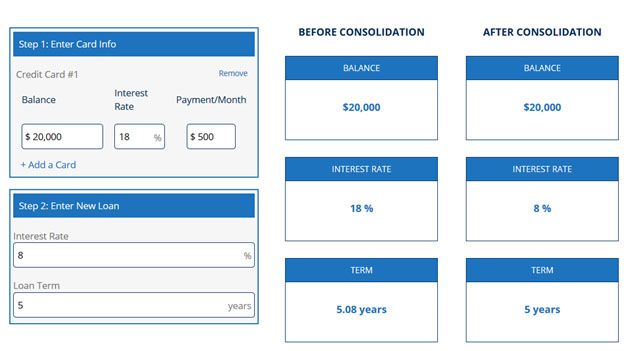
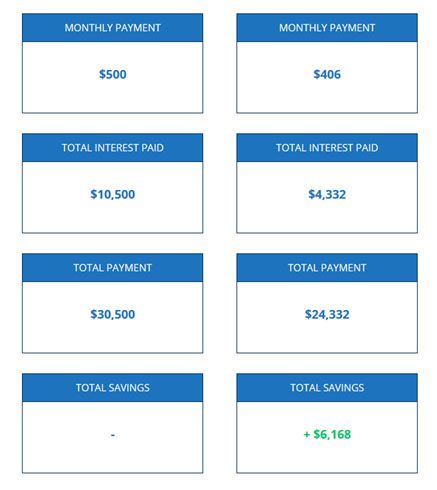
    Let’s look at an example with this credit card consolidation calculator.

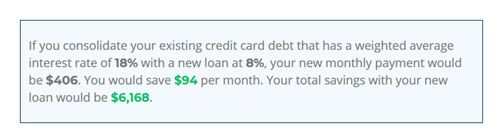
    Let’s assume that you have $20,000 of credit card debt at an 18% interest rate. Let’s assume that you can consolidate credit card debt with a personal loan with an interest rate of 8%.

    With this credit card consolidation calculator, you can see that you will save $94 per month, and your total savings on your credit card debt would be $6,168.

    As you can see, debt consolidation can save your significantly when you combine your credit card debt into a single personal loan.

    So, how do you get a lower interest rate?If you have raised your credit score since you borrowed your original debt, that can help you get a lower interest rate. Whether you have good or strong credit, you may qualify for a lower interest rate than the high-interest rates that come with credit cards.

    You can check your rates for free in two minutes and get a personalized quote for a new rate from these trusted lenders.

    2. Change your monthly payment

    One benefit of debt consolidation is the ability to change your monthly payment.

    Your monthly payment is based on your loan term (how long you have to payoff your debt), the amount of debt and the interest rate.

    When you consolidate credit card debt, for example, you can receive a lower interest rate and choose your loan term. Those are the two levers can you can pull to save money.

    You can decrease your monthly payment by increasing your loan term and thereby extending your payoff date.

    You can increase your monthly payment by decreasing your loan term and thereby shortening your payoff date.

    Whichever choice you make, you should make sure it is best for your specific financial situation.

    3. Change your loan payoff date

    Here’s a secret: the amount you pay each month for your current debt is based on your payoff date, which is known as your loan term. The good news is that with debt consolidation, you can change your payoff date and change your loan term.

    Here’s how.

    The longer your loan term, the less you will pay in interest each month. However, it will take you longer to pay off your loan. The shorter your loan term, the more interest you will pay each month. However, you can pay off your loan in a relatively shorter time period.

    So, you need to decide what type of loan term is best for you and works best for your financial situation. If you want to pay off your loan as quickly as possible – whether it’s a student loan, credit card debt or personal loan – choose a relatively shorter loan term. Yes, your monthly payments may be higher, but you will save money in the long-term.

    If you need more time to pay off your loan, remember that even though your monthly payments may be lower, you will end up paying more over the life of your loan. However, it may still be cheaper to do that rather than keep your existing debt at a higher interest rate.

    You can use this helpful monthly loan calculator to see how much you would pay each month under different scenarios. For example, a $10,000 loan at 8% interest payable over 5 years would mean a monthly payment of $203 and a total payment of $12,166.

    Top 3 Things To Avoid With Debt Consolidation

    Here are 3 things you should always avoid with debt consolidation:

    1. Focus on APRs

    An APR, or annual percentage yield, is the interest rate of your loan plus any origination fees.

    Pay attention to the APR, not only the interest rate.

    Personal loans and credit card consolidation loans often come with origination fees, which is industry standard. So, you shouldn’t be surprised if you see origination fees, which typically can range from 1-5% of your loan balance.

    So, when you look at the APR, you’ll have the full cost, including interest costs and fees.

    The good news is that even when you look at the APR, it can often be lower than the interest rate on your current debt.

    2. Avoid debt consolidation companies

    You don’t need a debt consolidation company to consolidate credit card debt.

    You can consolidate debt with a credit card consolidation loan or personal loan online in minutes. Most importantly, you can compare the best, high-ranked lenders and find the best one for you.

    Debt consolidation companies often over charge you and ask you to pay unnecessary fees. If you shop around and apply online yourself, you can save substantially compared to a debt consolidate service. Beware so you don’t fall for a debt consolidation scam.

    3. Get a debt repayment strategy

    A debt repayment strategy can help you get organized, stay organized and pay off your debt faster.

    Just because you got in debt doesn’t mean you have to stay in debt.

    Debt consolidation is your first step to get your finances under control. Whether it’s a student loan, credit card debt or a personal loan, you can consolidate debt and save money with a lower interest rate.

    Understand the reasons why you went into debt, control spending and don’t borrow money you can’t afford to repay.

    Most importantly, don’t spend money on a credit card if you can’t pay it back each month in full.

    Don’t skip payments and always pay on time.

    Should I consolidate my debt?

    Debt consolidation is an excellent tool not only to organize your debt but also to lower your interest rate and save you money.

    If you are happy with your interest rate and think it is already low, then debt consolidation may not be the best choice for you because it may not make good financial sense.

    However, if you think your interest rate is high, you can compare your current interest rate to the latest, personalized rates available today. When you comparison shop, you can find the best lender for you to help save you money.

    Remember, you can also choose your payoff date and loan term, and that will help you decide whether to extend or shorten how much time it will take to pay off debt.

    With debt consolidation, many people prefer to payoff debt as fast as possible, which is why the choice to consolidate debt can be a very good one.

    [related_posts post_1=’303′ post_2=’661′ post_3=’678′]

  • How To Pay Off Credit Card Debt

    How To Pay Off Credit Card Debt

    If you have credit card debt, you are not alone. There is more than $1 trillion of outstanding credit card debt in the U.S.

    With some credit card interest rates ranging from 10-25%, the interest costs alone can become crushing. The best way to pay off credit card debt is with a personal loan.

    [personal_loans_table]

    In this guide, we will discuss how a personal loans (also known as a credit card consolidation loan) can help you pay off credit card debt, save money and improve your credit score. For example:

    What is a personal loan?

    A personal loan, or credit card consolidation loan, is an unsecured loan typically from $1,000 – $100,000 with fixed or variable interest rates that can be used to make a large purchase or to consolidate debt. You can use a personal loan to pay off credit card debt, and save hundreds or even thousands of dollars in interest costs.

    The term “unsecured” means that there is no underlying collateral attached to the loan. For example, if you borrow a mortgage for your house, your mortgage is a “secured” loan in which your home is the collateral. If you default on your mortgage, your lender will then own your home.

    How do you get approved for a personal loan?

    Depending on your credit profile, you may be able to qualify for a low personal loan interest rate and save money compared to a credit card. If you want to know to get a personal loan, the application process is online is can be completed in minutes.

    Your personal loan interest rate will depend on several factors, which may include your credit score, credit history and debt-to-income ratio. Lenders want to see responsible borrowers who are likely to repay personal loans, who are trustworthy and creditworthy. To find the best rates for personal loans, you need to have a good to strong credit profile.

    When should you get a personal loan?

    Personal loans are best for purchases that you plan to repay in less than five years. While you can use a personal loan for many purposes ranging from home repairs and medical expenses to a wedding and honeymoon, the top reason to use a personal loan is debt consolidation.

    Credit card consolidation is one of the most popular reasons to get a personal loan.

    When you consolidate your debt, you combine all your existing debt into one loan so that you can make one monthly payment instead of multiple monthly payments.

    If you can obtain a lower interest rate by consolidating your debt compared with your current credit card interest rate, then a personal loan can help you to pay off your debt more quickly.

    If you have existing credit card debt, for example, you might be able to obtain a personal loan at a lower interest rate than your existing credit card interest rate.

    For example, let’s assume you have $20,000 of credit card debt at 18% interest, and you pay $500 per month.

    Let’s also assume that you can get a personal loan at 8% interest (depending on your credit profile and other factors). If you increase your monthly payment to $627 per month, you could pay off your credit card debt in 3 years and save $7,938.

    What is the best way to compare personal loans and credit cards?

    First, you need to compare the interest rate on your credit card with the interest rate on the personal loan to determine which interest rate is lower. Responsible financial borrowers should be able to obtain a lower interest rate with a personal loan.

    Second, you need to understand that if you do qualify for a lower interest rate, how many years you will have to repay your personal loan compared with your credit card debt and whether you are comfortable with the repayment period.

    Having a shorter-term loan repayment period can not only save you interest costs, but also instill discipline to retire your debt more quickly.

    Should you use a credit card loan to consolidate credit card debt?

    If you have credit card debt and want to lower your monthly payment and interest rate, then you should consider a credit card loan to consolidate credit card debt.

    A credit card loan enables you to consolidate credit card debt and combine your existing credit card debt into one credit card consolidation loan, which has one monthly payment.

    With a credit card consolidation loan, you may be able to obtain a credit card loan at a lower interest rate than your existing credit card interest rate. With the best personal loans, there are no origination fees and no prepayment penalties, which means you can save on fees and pay off your credit card loan faster.

    With the help of technology, you can learn your new, personalized rate within minutes. Plus, technology has lowered the fees for a personal loan, which means more money in your pocket and less in theirs.

    [related_posts post_1=’303′ post_2=’661′ post_3=’430′]

  • Refinance Student Loans Or Consolidate Student Loans?

    Refinance Student Loans Or Consolidate Student Loans?

    The decision to consolidate federal student loans or to refinance student loans is an important one. Since federal student loan consolidation and private student loan consolidation (also known as student loan refinance) are different, it is essential that you understand the differences before deciding which path to pursue.

    While consolidation of your federal loans means that you combine more than one loan into a single loan, refinancing means issuing a new loan (and paying off your existing student loans) with a new student loan with a lower interest rate.

    [refinance_student_loans_table]

    Student Loan Consolidation

    When you consolidate student loans, you can only consolidate your federal student loans. Consolidation of your federal student loans means that you combine more than one student loan into a single student loan, and the resulting interest rate is a weighted average of the student loans that were combined. With a single monthly payment, you are still afforded borrower protections such as flexible, income-driven student loan repayment plans and student loan forgiveness. More to come on those topics below.

    You can consolidate your federal student loans with the federal government. Since only federal direct loans qualify for consolidation, if you combine certain other student loans into a direct consolidation loan, you can gain access to the income-driven student loan repayment plans.

    Mentor Money Tip: If you have a Perkins loan and are considering consolidating your Perkins loan, you are better off keeping your Perkins loan outside of your student loan consolidation.

    Mentor Money Tip: The primary reason is that Perkins loans offer certain teacher student loan forgiveness and public service student loan forgiveness programs, and you would lose those benefits if you consolidate your Perkins loan.

    How To Apply For Federal Loan Consolidation In 5 Steps:

    1. Create a Federal Student Aid (FSA) ID through Federal Student Aid.
    2. Log on to the National Student Loan Data System (NSLDS) to view your loan types as well as balances and interest rates.
    3. Choose a repayment plan (income-based or basic)
    4. Apply for direct consolidation
    5. Pick a student loan servicer (FedLoan, Great Lakes, Nelnet, or Navient)

    You can also always call the federal government’s Loan Consolidation Information Call Center at 1-800-557-7392.

    What is an income driven repayment option?

    Income-Based Repayment Option

    The federal government offers four income-based and three basic repayment plans to help you repay your federal loans in a more financially manageable way. Let’s take a closer look to see if any of these options work well for you.

    • Income-based repayment
    • Pay As You Earn
    • Revised Pay As You Earn
    • Income-Contingent Plan

    Income-based repayment plans cap your monthly student loan payment based on a percentage of your income. The federal government allows you to repay your federal direct student loans based on your income. After 20 or 25 years, your loan balance is forgiven. In order to apply for any of these student loan repayment plans, you should visit the U.S. Department of Education, or through your loan’s servicer. Also make sure that you apply on time and reapply each year, since you have to update your income information each year in order to qualify.

    Mentor Money Tip: While an income-based repayment plan can lower your monthly payment, remember that it may now take longer to pay off your student loan.

    Mentor Money Tip: So make sure to balance your potentially lower monthly payment with your time goal to repay your loan.

    You can learn more about each of these student loan repayment options.

    What is a basic repayment plan?

    Basic Student Loan Repayment Plan

    There are three types of basic student loan repayment plans:

    • Standard Repayment
    • Graduated Repayment
    • Extended Repayment

    The basic student loan repayment plans do not depend on your income and you do not need to reapply each year. The default is the standard repayment plan, unless you otherwise choose the graduated or extended plan. The standard repayment plan involves making monthly payments based on your original loan term. If you can afford to make your monthly payments, you are better off staying with the standard monthly plan because you will pay off your loans on time and pay less in interest compared with an income repayment plan.

    Mentor Money Tip: No matter which student loan repayment option you choose, you can pay off your student loan faster by making an extra payment at any time.

    Mentor Money Tip: The more extra payments you can make, the faster you can repay your student loan and save on interest costs. Just remember to tell your student loan company to apply your extra payment to your principal balance, rather than toward your next payment.

    Student Loan Refinance

    Since the federal government does not refinance student loans, you can think of student loan refinancing as a form of private student loan consolidation – meaning that you refinance with a private lender, rather than the federal government. Many private student loan companies will refinance, though, both your federal and private student loans. When you refinance your student loan, your new lender pays off your existing student loan and issues you a new private student loan.

    Unlike a federal government loan, private student loans are credit-based, which means that your credit history and/or credit score may impact the interest rate on your new loan. Private student loan companies use different underwriting models to determine qualifications and interest rates. But you can expect that the stronger your financial profile and demonstrated financial responsibility, the lower your interest rate will be. The good news is that some private student loan companies enable you to have a co-signer (such as a family member), who will assume financial responsibility for your student loan and can help you obtain approval for your student loan application based on their financial profile.

    Why Refinance Student Loans?

    The primary reason to refinance student loans is the potential to receive a lower interest rate than your existing student loan. Federal student loans may have interest rates as high as 6.8% on an undergraduate student loan, and even higher for a graduate PLUS loan. You may have other private student loans at even higher interest rates that you borrowed while you were a student. Now that you have graduated and have an income and established a work history, private student loan lenders are likely to offer you a lower interest rate than these types of student loans.

    One downside of refinancing student loans is that you lose federal student loan protections such as income-driven repayment options, Perkins Loan cancellation, and public service loan forgiveness, and teacher-student loan forgiveness, among others. However, private lenders have sought to provide relief by offering loan deferment and forbearance options. You can learn more by checking with each lender on the benefits that they offer.

    Where can I refinance student loans?

    You can find and compare student loan rates from top private student loan companies who offer student loan interest rates as low as 2-3%. Plus, if you sign up for autopay, you can earn a 0.25% discount on your student loan interest rate, which add up to big savings over the course of your student loan term.

    Flexible Repayment Terms

    Private lenders offer borrowers multiple options to repay their loans, with terms ranging typically from 5 to 20 years. You also will have an opportunity to choose between fixed and variable interest rates. If you want to pay off your student loans and get out of debt as quickly as possible, then you will want to choose a shorter-term option (such as 5 years or 10 years).

    While you will save on interest costs (compared with a 20-year loan, for example), your monthly interest costs will be relatively higher than with a longer term loan option. However, you may be able to save money depending on how much money you save with your new interest rate.

    Student Loan Consolidation vs Student Loan Refinancing Calculator

    This student loan consolidation vs student loan refinancing calculator shows which option saves you more money on your federal student loans: consolidating into a Direct Consolidation Loan with the federal government or refinancing with a private lender.

    [related_posts post_1=’318′ post_2=’321′ post_3=’330′]

  • How to Refinance a Car Loan

    How to Refinance a Car Loan

    If you want to know how to refinance a car loan, the process to refinance your car loan makes sense in several circumstances:

    1. Interest rates are low. You want to refinance your car loan when the interest rate on your new loan is lower than the interest rate on your current loan. When you refinance, it is considered a used car loan, which makes sense since you have had our car for awhile. Fortunately, interest rates are relatively low so it is an opportune time to refinance car loan rates now before interest rates rise.
    2. Your credit score is stronger. If you have improved your credit card since you last got an auto loan, then now could be a great time to refinance a car loan. A stronger credit profile signals to lenders that you are financially responsible and trustworthy. It also increases the likelihood, from a lender’s view, that you will repay your car loan. Therefore, you can qualify a lower refinance car loans rates. Even slightly lower rates for your car loan can save you interest cost, which means more money in your pocket.
    3. You didn’t get the best rate then. Even if you had strong credit when you bought a car, that doesn’t mean you got the best auto loan rates. Today, there may be lenders who will refinance your car loan at a lower rate. The ability to refinance a car loan at a lower interest rate can save you significant money.

    [refinance_student_loans_table]

    When Not To Refinance A Car Loan

    The decision to refinance a car loan may not make sense in one of the following scenarios:

    • Car value less than loan balance. The value of your car is lower than the outstanding loan balance.
    • Car age.The age of your car is old compared to the maximum age that a lender will refinance your car loan.
    • Balance too high. The amount you want to refinance is more than the maximum amount for which a lender will refinance your car loan.

    You can always check the market value of your car on Kelley Blue Book, Edmunds or Auto Trader.

    How To Save Money When You Refinance Your Car Loan

    The decision to refinance your car loan can save you money because you are getting a new car loan with a lower interest rate than your current car loan. The proceeds from the new car loan are used to pay off your existing car loan, and then you only will make payments monthly on your new auto loan. The lower interest rate means you will save money each month, since there is less interest.

    If you have a stronger credit profile and make stable income, you may qualify for a lower interest rate. Auto loan lenders like to refinance a car loan for a borrower with a higher credit score because it demonstrates financial responsibility and creditworthiness. This provides more comfort that you are a responsible borrower who will repay the auto loan in full.

    How To Refinance A Car Loan: The Process

    “How do I refinance my car loan?” is a popular question asked when people want to know how to refinance a car loan. The process is simple and straightforward.

    1. Compare refinance auto loan lenders. To refinance your car loan, you can use Mentor Money for the best refinance auto loans. Mentor Money can help you compare car loan rates for cars side-by-side to find the best match for you.
    2. Apply online. You can apply directly to refinance your auto loan with one of Mentor Money’s partners.
    3. Fast application. The application is online and can typically be completed in 10-15 minutes.
    4. Approval decision. The good news is that the lender will respond often within 24 hours to let you know if you have been approved to refinance your car loan.

    Best Rates To Refinance Auto Loans

    On Mentor Money, you can compare cars side by side for the best rates to refinance auto loans.

    If you want to refinance a car loan, you get compare the lowest rates to refinance your car loan.

    [related_posts post_1=’375′ post_2=’378′ post_3=’574′]

  • New or Used Car?

    New or Used Car?

    Should You Buy A New or Used Car?

    When it comes to choosing between a new or used car, there are several considerations. Yes, you can analyze the market value of a car or use a car value estimator. Once you look at a used car valuation and a new car valuation, you can compare which option – a new or used car – works best for you.

    Despite the historical stigma that used car values are low because used cars are considered old, the fact is that used car values often are better than new car valuation due to depreciation.

    [refinance_student_loans_table]

    New or used car: what is depreciation?

    Believe it or not, your new car valuation may lose 20-30% of its value when you drive your new car off of the dealership lot. Yes, it is called depreciation and it impacts the market value of your car. Each year, the market value of your car will depreciate more as their increased wear and tear on your new car.

    Here is an example: Let’s say you are deciding between a new or used car, Which the best car to buy? A new car may cost $25,000. However, let’s say your sell that same car 5 years later for $10,000. That means that the market value of the car depreciated by $15,000 over 5 years.

    Now, let’s say you purchase a used car for $15,000 and sell it for the same $10,000 5 years later. In this case, the market value of the car depreciated $5,000 over 5 years.

    With the new or used car, you ended up with $10,000 when you sold it. However, the new car was $10,000 more expensive. So, when using a car value estimator to estimate a used car valuation versus a new car valuation, pay attention to the projected value in three, five or 10 years.

    What are the advantages of new cars?

    Even if new car valuation can be impacted by depreciation, the best car to buy for you may be a new car. Here are some advantages of new cars:

    1. Reliability. Buying a new car means you will be getting the newest model with the highest reliability. That means fewer repairs and your new car is likely covered by a warranty. Most car manufacturers offer a three-year warranty or for the first 36,000 miles.
    2. Advanced Features. A new car means the newest features and gadgets that can be harder to find with used cars. You will also find a new car has better fuel inefficiency.
    3. Financing. When it comes to financing a new or used car, it is easier to find the best auto loans for a new car. You also can find lower interest rates.
    4. It’s new. With a new car, you know that is brand new and you are the first owner.
    5. Price transparency. There is more price transparency with a new car. You can compare prices for your make and model across offers to see which new car valuation and price works best for you.

    What are the advantages of used cars?

    When it comes to a new or used car, the best car to buy for you may be a used car. Here are some advantages of used cars:

    • Less depreciation. Used car valuation can be better than new car valuation because of depreciation. For example, you could lose 30% of your purchase price when you drive off the dealership lot.
    • Lower car insurance rates. The best car to buy for insurance is a used car because it costs less to insure a used car.
    • Lower cost to register. Since you have a used car, the cost to register each year also will be less.
    • More bang for your buck. Since used car values won’t be impacted as much by depreciation, you have more purchasing power to buy the car of your choice.
    • Ok to get dirty. Unlike a new car, you will feel less stressed if your used car gets dirty or in a fender bender. After all, it’s a used car and the market value of the car is less impacted by its age. Focus on reliable cars that perform well even after 100,000 miles.

    Best Auto Loans: New or Used Cars

    Once you have selected a new or used car, you can compare the best auto loans on Mentor.

    [related_posts post_1=’375′ post_2=’378′ post_3=’574′]

  • How to Consolidate Credit Card Debt

    How to Consolidate Credit Card Debt

    If you’re wondering how to consolidate credit card debt, you can learn how to save money and get out of debt faster. Credit card consolidation is one of the smartest financial strategies to organize and manage your credit card debt, while saving money. Today, credit card debt is a $1 trillion issue. So, if you have credit card debt, you’re not alone.

    Credit card consolidation is the process of combining all your credit card debt into a single loan with a lower, fixed interest rate that simplifies the credit card debt repayment process and saves you money. “How do I consolidate credit card debt?” is a popular question that we are asked at Mentor.

    If you want to consolidate credit card debt, a personal loan – which is also known as a credit card consolidation loan – can lower your interest rate and lower your monthly payment.

    [personal_loans_table]

    What Is A Credit Card Loan?

    A credit card loan is an unsecured loan typically from $1,000 – $100,000 with a fixed interest rate that is used to consolidate credit card debt and lower your current interest rate. A credit card loan is a short-term loan that is typically repaid in 3-5 years, and offers a monthly repayment feature that includes both principal and interest. Some lenders offer repayment options from 2-7 years to provide more flexibility for repayment.

    How Is A Credit Card Loan Different From Other Types of Loans?

    A credit card loan is different from other types of loans in several ways.

    First, a credit card loan is an unsecured loan. An unsecured loan means that there is no collateral attached to a credit card loan. For example, if you borrow a mortgage, your home becomes the collateral for your mortgage. If you default on your mortgage, your lender will then own your home.

    With a credit card loan, there is no underlying collateral if you want to consolidate credit card debt. When a loan has no collateral, it means that the loan is an unsecured loan. Since the lender assumes more risk with an unsecured loan, the interest rate on a credit card loan is higher than the interest rate on a mortgage.

    Second, a credit card loan typically has a fixed interest rate, which means that your interest will never change. For example, if the Federal Reserve raises interest rates, a fixed credit card loan will not be impacted and you will continue to make the same monthly payment and interest rates. This makes credit card loans more predictable.

    When you compare a credit card loan to a credit card, you can see that a credit card has variable interest rate. A variable interest rate means that you credit card payment can increase when interest rates rise, which can cost you more money. When you have a variable interest rate, your monthly payments may be unpredictable, and ultimately may be more expensive if interest rates continue to rise.

    How A Credit Card Loan Helps You Save Interest When You Consolidate Credit Card Debt

    If you want to consolidate credit card debt, a credit card loan helps you cut the interest rate on your existing credit card debt.

    A credit card loan combines all your existing credit card debt into a single credit card loan with one monthly payment. When you consolidate credit card debt, the resulting interest rate is equal to the weighted average of the interest rates of your existing credit card debt.

    The good news is that interest rates on credit card loans are often much lower than the interest rates on credit cards, which typically range from 10-20%.

    This means that you can use a credit card loan to lower your interest rate and lower your monthly payment, which can help you consolidate credit card debt and pay off your debt more quickly.

    When Should You Use A Credit Card Loan To Consolidate Credit Card Debt?

    The best part about a credit card loan is that you can use it at your discretion on the financial decisions most important to you.

    Unlike a student loan or mortgage, which must be spent on school or a home, you decide how and when to spend your credit card loan.

    Credit card debt consolidation is your intended use to consolidate credit card debt, but you do have the discretion to use your credit card loan for other purposes.

    Should You Use A Credit Card Loan To Consolidate Credit Cards?

    If you have credit card debt and want to lower your monthly payment and interest rate, then you should consider a credit card loan to consolidate credit card debt.

    This credit card consolidation calculator can show you how much money you can save when you consolidate credit car debt.

    Here’s a good rule to remember: if you can get a credit card consolidation loan or personal loan at a lower interest rate than the interest rate on your credit card, then it may be advantageous to consolidate credit card debt. Conversely, if the interest rate you receive is higher than the interest rate on your credit card debt, you may want to consider other options.

    Bottom line: compare the two interest rates and determine which one is lower. Remember, a personal loan or credit card consolidation loan typically has a fixed interest rate, so you may save more money compared to a variable interest rate if interest rates rise.

    You can learn your new rate online for free within minutes.

    Today, the average credit card interest rate is 16.5%. For example, if you have $10,000 of credit card debt at 14% interest and can obtain a credit card loan at 6% interest, you could potentially cut your interest payments by more than 50%.

    [related_posts post_1=’303′ post_2=’661′ post_3=’678′]

  • How to Buy a Car

    How to Buy a Car

    How To Buy A Car: The Basics

    When it comes to how to buy a car – whether you buy cars online or buy cars at a car dealership, there are certain strategies to follow. The process of buying a car can be easy if you follow these key steps.

    1. Choose a budget. The top thing of what you know when buying a car is your budget. When buying a new car, determine how much you want to spend on your car.
    2. Financing. The best way to buy a car often can be with a car loan. Figure out the size of your car loan and what the monthly payments will be. You can compare the best auto loans directly on Mentor.
    3. Research cars. Determine if the car you want meets your needs and preferences. Check fuel efficiency, safety and other important features that are important to you in your process of buying a car.
    4. Test drive cars. As you narrow your search, you can test drive cars at dealerships. One of the best ways to buy a car is to speak with a dealership to answer your questions when you test drive the car.
    5. Choose a car. Once you have test-driven several cars, select the car, make and model that works best for your needs.
    6. Online Comparison Shop. Check available cars online and find inventory. Research the cost of your car and how much other people paid for the same or similar model.
    7. Dealership Comparison Shop. In addition to researching to buy cars online, you should check with dealerships to get price quotes.
    8. Trade-in value. If you have a car, one smart strategy of buying a car in trading in your old car. Determine the highest value you can get when you trade in your old car.
    9. Sign, Sealed, Delivered. Congratulations. It’s time to review the contract, and sign.

    [refinance_student_loans_table]

    What is the best way to buy a car?

    If you want to know the best way to buy a car, the process of buying a car is so much easier when you do your homework. When people ask “what do I need to buy a car,” the best resources to buy a car include Kelley Blue Book, Edmunds, Consumer Reports and AutoTrader. If your goal is buying a new car, then research the “invoice price” of the new car, rather than manufacturer’s suggested retail price (MSRP). The invoice price is the price the dealership paid to the manufacturer, which will help you understand the dealer’s true cost. If your goal is buying a used car, you should understand what other people paid for the same or similar car. Understand the trade-in value of your current car that you can use as a credit against buying a new car.

    You can use services such as CarsDirect and TrueCar to buy cars online.

    What expert advice should I know when buying a new car?

    The process of how to buy a car doesn’t have to complex. Here are insider tips of how to buy a car, whether you want to buy cars online or through a dealership:

    • Do your research. The secret of how to buy a new car is to empower yourself with knowledge regarding the car price and invoice price, in particular.
    • Rent the car you want. It’s an easy way to determine if it is the right car for you.
    • Visit the dealer after hours. The best time to see your favorite cars may be after hours when there are no salespeople around to “sell” you.
    • Avoid optional packages. A dealership may try to tack on additional fees and packages at the last minute. If you don’t need these extra packages, feel free to pass.
    • Negotiate. The process of buying a car is one big negotiation. This is one of the number one things of what to know when buying a car. Be prepared for a long negotiation and comparison shop to get the best price.
    • Understand the full price. The price of a new car is not only the car price. Understand the total price, including all fees and taxes so you know how much it truly costs when buying a new car or buying a used car. Also understand the maintenance and repair costs for your car once your warranty expires.

    What documents do you need when buying a new car?

    When buying a new car, you likely will need at least the following documents:

    • Driver’s license
    • Proof of insurance
    • Proof of income
    • Proof of residence
    • Contact information (address and phone number)

    What fees are there when buying a car?

    The process of buying a car will include a contract that may have additional prices beyond the price of the car. Here are some fees to be aware of when buying a new car:

    • Sales Tax. The state where you purchase the car may charge state sales tax.
    • Registration Fees. Whether you register the car yourself or the dealer registers the car for you, there will be registration fees.
    • Documentation Fees. Documentation fees are charged by a dealership to complete the contract and any other paperwork.

    Fees may be negotiable so don’t feel like you cannot negotiate fees, particularly if any of the fees do not look standard to you.

    [related_posts post_1=’375′ post_2=’378′ post_3=’574′]

  • Complete Student Loan Repayment Guide

    Complete Student Loan Repayment Guide

    Welcome to the Mentor Student Loan Repayment Guide

    There are many options for student loan repayment, ranging from student loan refinancing to income-driven repayment plans. In this student loan repayment guide, we will cover everything you need to know about the best ways to pay off student loans.

    You may have done your homework, explored your student loan refinancing options, understand which student loans you have and how much you are paying currently, but you still aren’t sure if you are on the best student loan repayment plan for your budget. You dive into all of the options for student loan repayment, but now you find yourself feeling like you’ve got more choices than a buffet.

    Don’t stress — we’ll make it easy for you.

    Explore our easy to follow Mentor Student Loan Repayment Guide below and we will help you figure out which options can meet your student loan repayment needs. Mentor has a helpful Student Loan Forgiveness Guide as well, but this student loan repayment guide is for those borrowers looking at the student loan repayment options, when student loan forgiveness is not an option for you.

    The first thing you need to know is that there are two groups of student loan repayment plans to look out for.

    The first group contains the traditional student loan repayment plans. These plans are what you will originally be offered when your student loan repayment period starts. They have nothing to do with how much you earn or how much you borrowed and can be used to repay just about any kind of student loan.

    The second group of student loan repayment plans are options for borrowers to structure their student loan repayment based on their income. These plans each have specific benefits and limitations. In most cases, these student loan repayment plans reduce your monthly payments, but may extend the life of your student loan. These plans are only available to certain federal student loans. While the highlights of the student loan repayment plans are below to help you compare – as with any dotted line you planning on signing your name to – we encourage you to read the fine print before making it final!

    Compare rates and pay off student loans faster

    With student loan refinancing, you can combine existing federal and private student loans into a single student loan with a personalized lower interest rate and lower monthly payment.

    [refinance_student_loans_table]

    Traditional Student Loan Repayment Plans

    Before the federal government instituted repayment plans, traditional student loan repayment plans were the only options for student loan repayment and in many, although not all, cases they still can offer an effective strategy to pay down your student loans. Under these student loan repayment plans, you will be responsible for paying off your student loan debt yourself, but you can control how quickly you pay it and how much you pay at a time.

    Let’s take a look at the federal student loan repayment options.

    Standard Student Loan Repayment

    Standard Student Loan Repayment is just what is sounds like. Take no action and this is likely where you will land. All student loans are eligible for this type of student loan repayment and the maximum term is 10 years. Payments are fixed and because you make a higher monthly student loan payment compared to other student loan repayment plans, not only do you pay your student loans quickly, but also you pay less over the long term. Take that, interest and compound interest!

    Extended Student Loan Repayment

    The Extended Student Loan Repayment gives you a little breathing room and does exactly what it suggests – extends the length of your student loan repayment.

    How do you know if this student loan repayment plan is right for you? Well, if you’re staring down the barrel of a monthly student loan payment on a 10-year plan and thinking…what was I thinking?! You were planning on making a student loan repayment every month on time, but when you start dividing what you borrowed by 10 years, and then 12 months and adding interest and compounding interest, the math does not compute. By repaying your student loan for a longer period of years, you have the ability to make smaller monthly student loan payments. The major drawback to this approach is of course the interest that accrues and compounds and accrues and compound and…. yeah, that.

    Payments Based On What You Earn

    Payments Based On What You Earn, otherwise known as Income Driven Plans, are only available for certain federal student loans (not private student loans), and they use different formulas to calibrate your student loan payments based on your income. The federal student loans generally must be consolidated under the Federal Direct Loan Program (FDLP) or must be paid through the Federal Family Education Loan Program (FFEL). You have to apply for these programs through the U.S. Department of Education.

    If you qualify, these student loan repayment plans almost always result in lower monthly student loan payments and student loan forgiveness as to any remaining balance at the end of the student loan repayment tern. You will pay income tax on the remaining amount to be forgiven (only in the year it is forgiven).

    Income Contingent Repayment

    Income Contingent repayment, or ICR is, like all of IDR plans, directed at reducing the burden of repaying high student loan debt on borrowers with lower income. It specifically considers those borrowers working in public service. In order to qualify for ICR, you must have consolidated your student loans through the FDLP student loan consolidation. Parent PLUS Loans are not eligible for the ICR program, but Direct Parent PLUS Loans, which are part of a student loan consolidation, are eligible.

    The maximum student loan repayment period under this plan is 25 years. Like all IDR plans, at the end of the student loan repayment period, any remaining debt is forgiven. The student loan interest rate is fixed, but you are not locked into ICR for life and you may switch plans if you choose. Unpaid student loan interest can only be capitalized at 10 percent of the original loan amount. Your student loan payment will change every year depending on your income and family size. Depending on those numbers, if your salary increases, you could be repaying your student loan at a rate even higher than the 10-year standard student loan repayment plan.

    You can calculate your monthly student loan payments and student loan forgiveness with the Mentor Student Loan Income-Contingent Repayment (ICR) Calculator.

    Income Based Repayment

    Income Based Repayment, or IBR, requires you to have a partial financial hardship to qualify. IBR generally has a broader reach than ICR and is available under both FFEL and FDLP. Neither Parent PLUS loans nor Direct Parent PLUS loans are eligible.

    Under IBR, monthly student loan payments will generally be 10 percent of your discretionary income if you’re a new borrower on or after July 1, 2014, but these payments will never be higher than the 10-year standard repayment plan. If you’re not a new borrower by that date, you are looking at a monthly student loan payment capped around 15% of your discretionary income.

    That said, your student loan payment will never be set at a rate higher than the 10-year standard repayment plan. Depending on when you borrowed, your student loan repayment plan will either be 20 or 25 years. As with all of the IDR plans – at the end of the student loan repayment period, the remaining balance is forgiven.

    Don’t forget – you have to recertify every year. If your income goes up, so will your student loan payments, but under IBR, payments will never exceed the 10-year standard student loan repayment rate.

    You can calculate your monthly student loan payments and student loan forgiveness with the Mentor Student Loan Income-Based Repayment (IBR) Calculator.

    Pay As You Earn (PAYE)

    Pay As You Earn, or the PAYE plan, is an income-driven repayment plan that was created in 2012 in order to relieve student loan debt and was specifically directed at students graduating that year. As a result, PAYE has very specific requirements and is only available to a narrow group of borrowers. However, if you graduated in 2012 (or if you took out loans after Oct 1, 2007 and received a disbursement after October 1, 2011), this student loan repayment plan could be for you. Like IBR, you must prove that a 10-year standard repayment plan will not be affordable for you. Generally, payments are capped at 10 percent of your discretionary income, but like IBR, even if your income goes up, payments will never be higher than the 10-year Standard Repayment Plan amount.

    You can calculate your monthly student loan payments and student loan forgiveness with the Mentor Pay As You Earn (PAYE) Calculator.

    One More Thing…

    I heard about this Public Service Loan Forgiveness Program – isn’t that a student loan repayment plan?

    No, not exactly, but certain borrowers can be eligible for student loan forgiveness after making 120 qualifying payments if they enroll in the Public Service Loan Forgiveness Program. The Public Service Loan Forgiveness program is a federal program create by President George W. Bush that forgives federal student loans for borrowers who are employed full-time (more than 30 hours per week) in an eligible federal, state or local public service job or 501(c)(3) non-profit job who make 120 eligible on-time payments over ten years. You must make a majority of your student loan payments while enrolled in an income-driven repayment plan, to qualify for public service loan forgiveness.

    Revised Pay As You Earn (REPAYE)

    Revised Pay As You Earn, or the REPAYE plan, is an income-driven repayment plan that was announced as a revision to the PAYE program. Unlike PAYE, which is targeted at 2012 grads, REPAY is available to anyone with federal direct loans. Also unlike PAYE, you do not have to prove that the 10-year standard repayment program is unaffordable for you, so borrowers at any income level can apply.

    If you have undergraduate student loans, your student loan payments will end after 20 years, and if you have graduate student loans, your student loan payments will end after 25 years. Generally, student loan payments will be capped at 10 percent of your discretionary income. REPAYE also provides an interest subsidy payment to borrowers in cases where payments under the REPAYE plan cannot keep up with accrued interest on the student loans.

    One word of caution – like the ICR plan – if your income ever spikes, you could find yourself making very high payments. You must recertify every year and student loan payments will always be based on income (and will never be capped, even at the 10-year standard rate).

    You can calculate your monthly student loan payments and student loan forgiveness with the Mentor Revised Pay As You Earn (REPAYE) Calculator.

    [related_posts post_1=’318′ post_2=’327′ post_3=’330′]